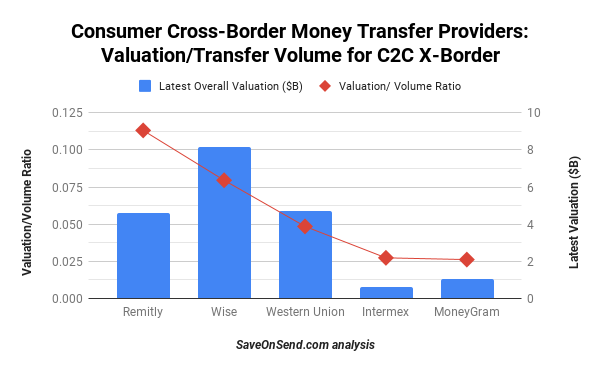
Do remittance startups have a fundamentally different cost structure vs. incumbents? What are the primary customer acquisition channels for money transmitters? What explains remittance startups’ much higher relative valuations than established providers? If you are interested in such questions, this article is for YOU.
“Revolution is a rough business. You can’t make it wearing white gloves and with clean hands”
Lenin
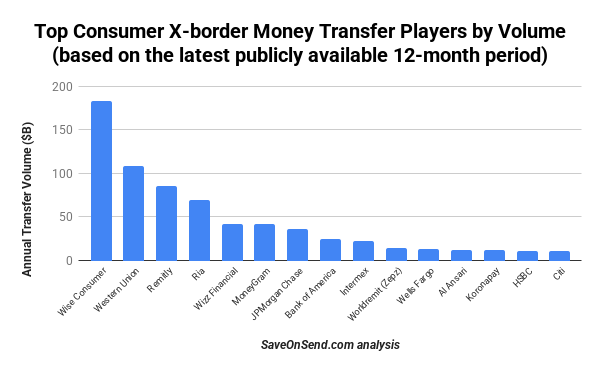
Wise’s (ex-TransferWise) origins are often described as follows: Two Estonians, a former Skype employee, and a Deloitte consultant became fed up with the exorbitant fees charged by banks for money transfers from the UK to Estonia. Fueled by their frustration, they had a stroke of brilliance – matching remittance senders and receivers within the same country. With a sauna in their office and a team unafraid to challenge the banking industry, TransferWise was born. The startup received backing from prominent investors such as Peter Thiel, Richard Branson, and Ben Horowitz, propelling it to the pinnacle of fintech for cross-border consumer transfers, surpassing a $10 billion valuation in 2021, and transferring by far more volume than any incumbent or fintech.
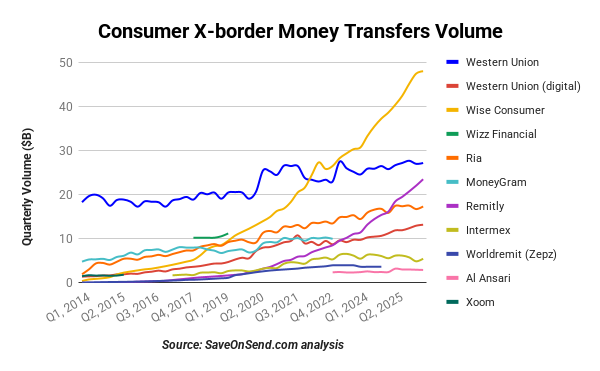
Disruption takes only one determined startup with a long-term vision spanning two or more decades. The disruptive force of innovation only requires one Amazon for books, one Spotify for music, and one Netflix for entertainment. Over two decades after Xoom’s founding as the first fintech in cross-border money transfers, two fintechs have emerged ahead of the pack: Wise and Remitly.
They got there by attacking different parts of the market. Wise primarily targeted banks’ cross-border transfer customers, while Remitly targeted traditional MTO customers as a better mobile version of Xoom. There is some overlap, but each is attacking a cross-border consumer market worth roughly $1 trillion in annual volume. More than a decade of keen observations in this fiercely competitive space has given us a reasonable understanding of what made Wise and Remitly so far ahead of others, and why some fintechs are no longer around.
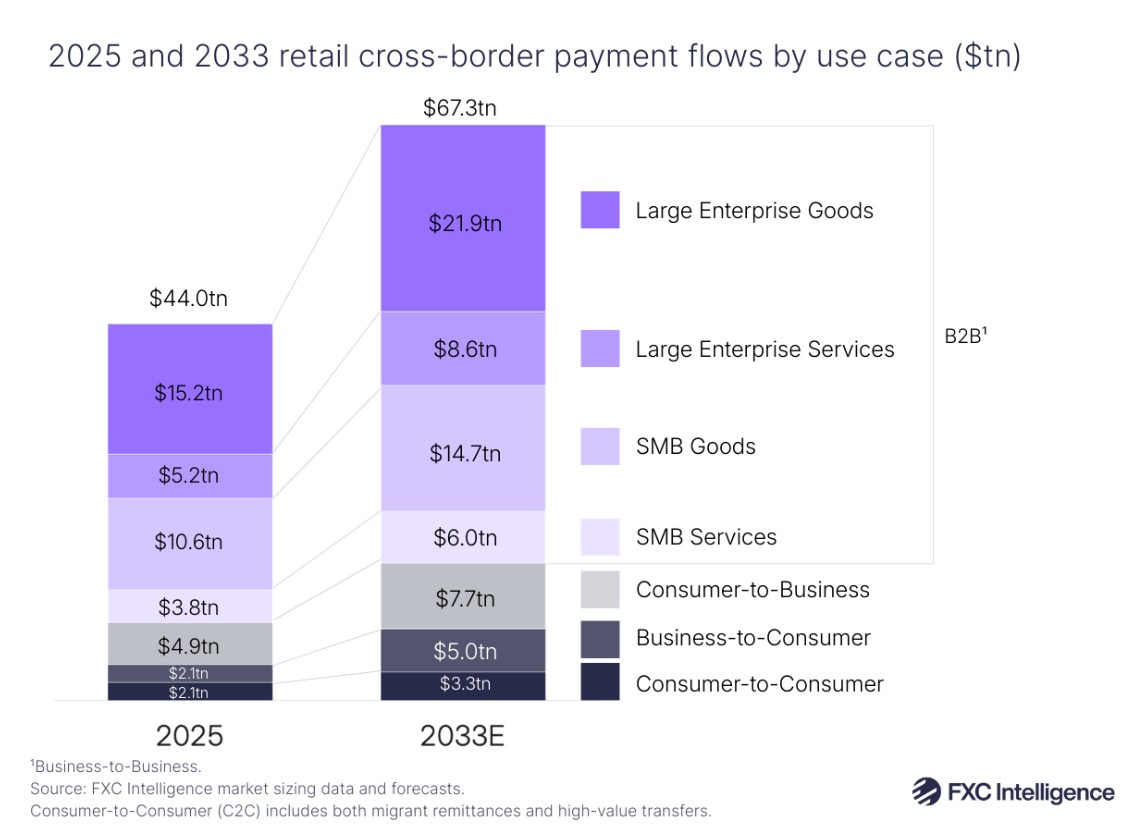
Digital-dollar access: buying or holding stablecoins without transferring them internationally.
Consumer remittance: an individual sends money to another individual.
Business payment or treasury: companies move working capital, supplier payments, or FX liquidity.
Wholesale settlement: regulated institutions settle obligations between themselves.
Blockchain infrastructure: the ledger or messaging layer, regardless of the currency transferred.
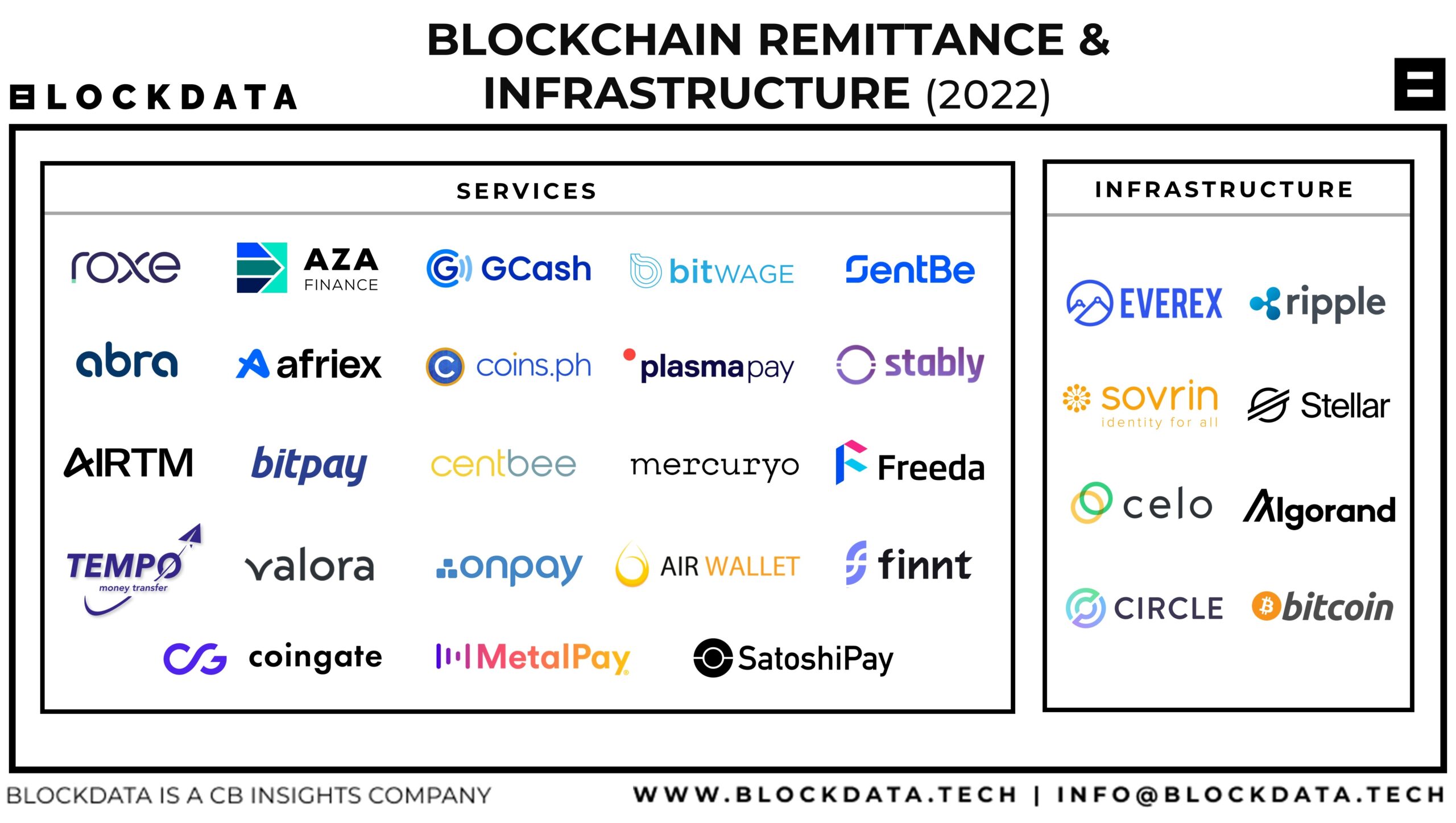
Since the publication of “Bitcoin: A Peer-to-Peer Electronic Cash System” in 2008, international money transfers, although constituting a smaller portion of cross-border payments, have emerged as one of the most promising use cases for crypto.
The original thesis was simple: remittance users paid high prices for slow, opaque service, while blockchain could move value almost instantly at negligible rail cost. Crypto founders and investors also framed it as a way to bypass banks and reach underserved recipients. Startups raised capital to test that thesis through consumer services and MTO partnerships. El Salvador later turned it into a national experiment by making Bitcoin legal tender and promoting it for remittances.
After more than a decade of pilots, crypto has not displaced conventional consumer remittance rails at a meaningful, independently verified scale. Stablecoins have nevertheless become a credible back-end option in select corridors and a useful instrument for digital-dollar access, treasury mobility, and certain high-friction cross-border flows. Most disclosed consumer-remittance implementations remain selective routes, subsidized programs, or company-reported deployments whose scale and unit economics are not independently verifiable.
The decisive question is therefore whether the full end-to-end system, including funding, FX, compliance, liquidity, payout, cash-out, support, fraud, and reversibility, beats modern fiat alternatives on price, speed, reliability, and scale. Public evidence remains strongest for digital-dollar access and some business or treasury use cases, and weakest for broad consumer-remittance transformation.
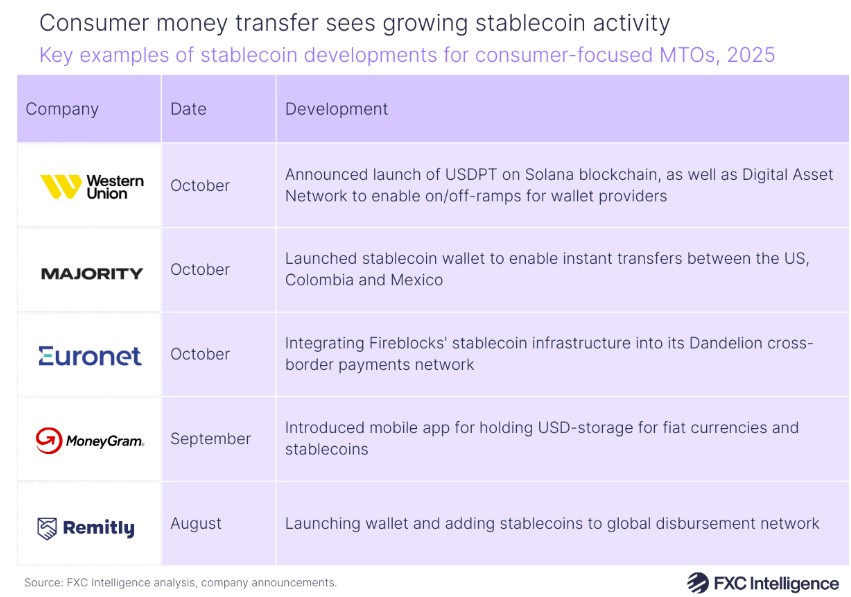
By 2025, stablecoins had moved from fringe remittance experiments into the product roadmaps of major consumer money-transfer providers. Western Union, Euronet, MoneyGram, Majority and Remitly announced stablecoin wallets, on- and off-ramps, disbursement capabilities or integrations into their existing cross-border networks. This marked an institutional turning point, although in 2025 it still mostly measured announced capabilities rather than consumer usage or transfer volume.
By mid-2026, several of those roadmaps had moved into production. Euronet launched stablecoin payouts; Western Union launched USDPT and Stablecard, with the latter live in 37 markets; MoneyGram launched MGUSD; and Remitly launched a stablecoin card and wallet in selected Latin American markets. This is stronger evidence of institutional adoption than the 2025 announcements. But the cited disclosures still do not quantify how much consumer-remittance volume actually uses stablecoin settlement or demonstrate a reduction in customers’ total fees and FX markup.
MoneyGram does disclose one measure of internal scale: its stablecoin FX trading runs at roughly $2 billion annualized. But that is treasury and FX activity, not disclosed consumer-remittance settlement volume or evidence of lower customer prices.
PYUSD provides an even cleaner warning against treating stablecoin circulation as payment adoption. Its first major boom came after PayPal launched on Solana in 2024, and PYUSD paid roughly 15–18% yields on Kamino and Drift; circulation crossed $1 billion, then fell sharply as those incentives faded. The pattern repeated at much larger scale in 2026. Around PYUSD’s $4.1 billion peak, Ethena alone held $1.13 billion and Aave about $445 million. PayPal then expanded PYUSD availability to 70 markets, explicitly promoting cross-border transfers and dollar access, yet circulation subsequently fell by roughly $1.3 billion as those large DeFi positions unwound.
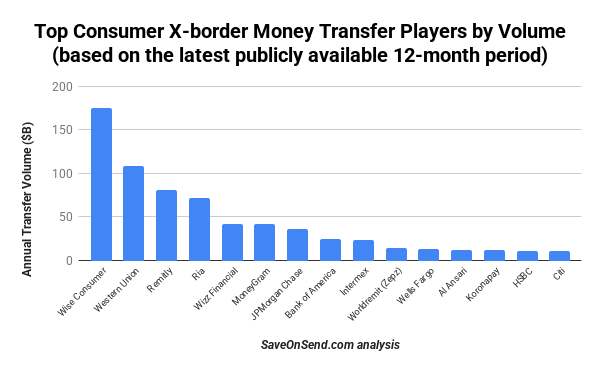
A more revealing comparison is how leading digital remittance players actually reached scale. Wise and Remitly became global consumer remittance leaders by improving the entire P2P proposition: digital customer acquisition, bank funding, compliance, FX, risk management, and local payouts. They reached that scale before adding stablecoins, if they added them at all. Even in Africa, where stablecoins supposedly rule, Zepz (WorldRemit + Sendwave) and LemFi became two of the continent’s largest digital remittance players before adopting stablecoin infrastructure.
Innovation Adoption: 3 Cases
Stablecoins do not need to replace every remittance rail to become material. They need to win decisively in at least one of three ways: solve a customer problem incumbents leave unresolved, support a business model incumbents cannot match, or create new transfer demand. The rest of this article tests each path.
“…to date MoneyGram has refused to open a meaningful dialogue with us, leaving us no choice but to make this proposal public…”
Euronet CEO’s letter to employees, December 13, 2007
In the past, MoneyGram and Western Union were often called the “monopolies” of cross-border money transfers. However, MoneyGram’s valuation was much smaller than Western Union’s, and it traded at a lower multiple than any competitor at the time.
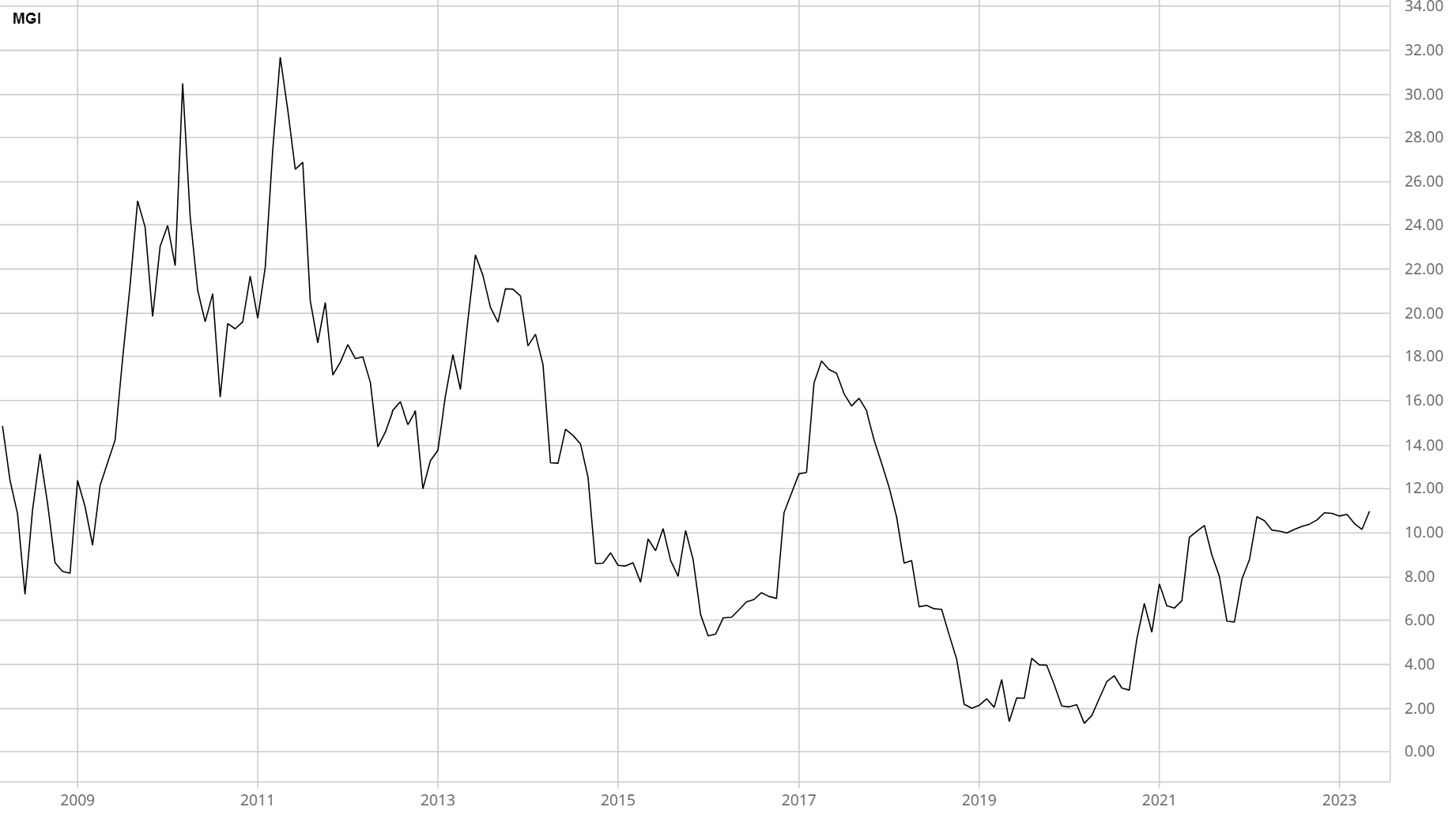
MoneyGram’s valuation had been erratic since its IPO in 2004, even reaching near-zero levels in 2019 and 2020, until it was finally acquired by a private equity firm, Madison Dearborn Partners, in 2023:
Throughout its history, MoneyGram has stood out as the most irrational player in remittances, defying the stereotype that incumbent financial services companies are too conservative. The only explanation for such behavior could be the curse of an eternal “silver medal.”
The foundation of PR pitches for money transfer startups rests on a relatively intuitive view of banks: they are massive institutions with bureaucratic cultures, subpar customer service, and outdated digital capabilities. From there, the pitch makes a bigger leap: banks will eventually be displaced from cross-border money transfer. The diagnosis is mostly right: typical banks are usually behind leading fintech startups in service quality and pricing, and most do not consider money transfers strategic. The displacement conclusion is where the pitch breaks.
Why Banks Don’t Take Money Transfers Seriously
It would be naive to assume banks aren’t concerned about competition. In the United States alone, 4,000 banks and countless credit unions compare their strategies obsessively with local and national competitors. However, banks naturally view their competition pragmatically: “What are the top five reasons for revenue slowdown?” or “Which new business trend could jeopardize 10% of profits?”
You have probably heard that the market size of consumer cross-border money transfer services is substantial. Remittances alone amount to a trillion in volume, and the overall cross-border consumer money transfer volume is about twice as large. However, with an average margin of less than 4%, $2 trillion in volume translates to about $70 billion in global revenues for the consumer cross-border money transfer industry. Because banks generate most of their revenue domestically, the portion of money transfer revenue relevant to banks is much smaller. The United States, the world’s largest outbound market for consumer money transfers, accounts for about 20% of global revenue, totaling around $15 billion.
“… long, sorry decline has left the 140-year-old company a shell of its former self. Today, it is fighting for its very survival. Western Union fell victim to technological advances…”
Reading current reporting on Western Union’s role in international remittances could lead us to think the company has been a successful monopoly in this space forever. Still, with the arrival of disruptive innovations (“P2P”, “Bitcoin-stablecoin“, “Social”, “Mobile”, …), it faces a real risk of imminent demise. In reality, Western Union’s subsidiary, Western Union Financial Services Inc., began offering international money transfers in 1982, following deregulation. By the mid-90s, Western Union’s coverage included major remittance destinations, such as China. In those early years, Western Union (renamed “New Valley” in 1991) faced numerous upheavals and came close to, or even entered, bankruptcy. After changing hands a few times, the money transfer subsidiary was resurrected as an independent entity in 2006. Western Union’s stock performance has been highly volatile ever since, dwarfed by the overall market:
Why did Wise and Remitly become global leaders while most money-transfer fintechs stalled or disappeared? Why do banks still handle roughly 40% of U.S. outbound consumer volume despite weaker pricing and digital products? Why does cash remain important after a decade of rapid digital adoption? What actually determines whether a new corridor, technology, or business model improves economics? And do stablecoins solve a meaningful part of cross-border transfers, or mostly replace one piece of the plumbing?
Those are the kinds of questions we investigate at SaveOnSend: how consumers actually behave, how providers really make money, and why the industry often evolves very differently from the disruption stories told about it.
Xoom’s two-decade-plus history is full of missed opportunities and second chances. The child of the so-called “PayPal Mafia” and protege of Sequoia Capital, Xoom was founded in 2001 to disrupt cross-border remittances. At that point, Western Union already had a website where customers could initiate and track money transfers, but it was clunky and saw little use. The shift to online remittances was expected imminently, so creating an online-only provider with a better user experience was a no-brainer.