

“High fees, large incumbents, and a $400B+ market are under attack by a slew of remittance startups.”
CB Insights, February 26, 2015
Disruption takes only one determined startup with a long-term vision spanning two or more decades. The disruptive force of innovation only requires one Amazon for books, one Spotify for music, and one Netflix for entertainment. Over two decades after Xoom’s founding as the first fintech in cross-border money transfers, two fintechs have emerged ahead of the pack: Wise and Remitly.
They got there by attacking different parts of the market. Wise primarily targeted banks’ cross-border transfer customers, while Remitly targeted traditional MTO customers as a better mobile version of Xoom. There is some overlap, but each is attacking a cross-border consumer market worth roughly $1 trillion in annual volume. More than a decade of keen observations in this fiercely competitive space has given us a reasonable understanding of what made Wise and Remitly so far ahead of others, and why some fintechs are no longer around.
The good news for fintechs over the last decade has been that the market has continued to grow. The overall volume of consumer cross-border money transfers now exceeds $2 trillion. In remittances alone, the volume has been increasing by $25-50 billion annually.
Three years later, in 2018, some of the same folks were predicting that cash agents would completely vanish within the next five years:
Not only did none of that transpire, but in 2022, Azimo’s struggles led to its acquisition by a payroll company to salvage parts of its payment technology. Competition among money transfer players has proven far more challenging than expected, while incumbent banks and MTOs have proven far more resilient.
Money Transfer “Disruptors”
Around 2010, the potential to disrupt consumer cross-border money transfers seemed enormous. The prevailing perception was that established players like Western Union, MoneyGram, and Ria were committed to their brick-and-mortar branches and might be unwilling or unable to provide consumers with a more streamlined digital alternative. Xoom had been in the market for a few years and was growing significantly, but it targeted only outbound corridors from the United States. Moreover, given the market’s immense size, it seemed feasible to accommodate multiple fintechs, especially during the early stages of the digital revolution.
Hence, the aspiration to become a larger, superior alternative to Western Union didn’t seem too daunting. So, a new generation of fintech founders challenged the CEOs of established money transfer businesses.
Some of the noteworthy startups that emerged during those years were:
- Zepz, aka WorldRemit (founded in 2009)
- TransferWise (2011)
- Remitly (2011)
- Azimo (2012)
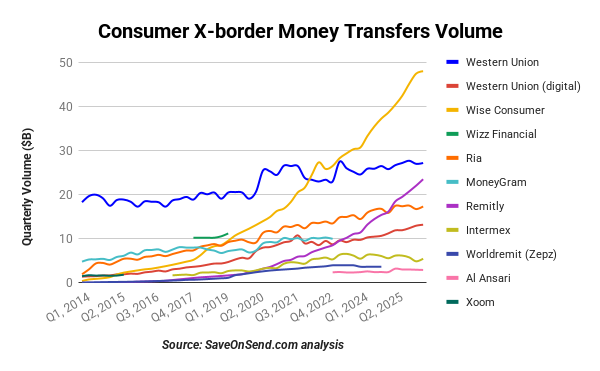
While Azimo is no longer around, Wise passed Western Union’s transfer volumes in 2022, and Remitly has inched closer to overtaking Western Union volumes:
Has the disruption affected traditional players so far?
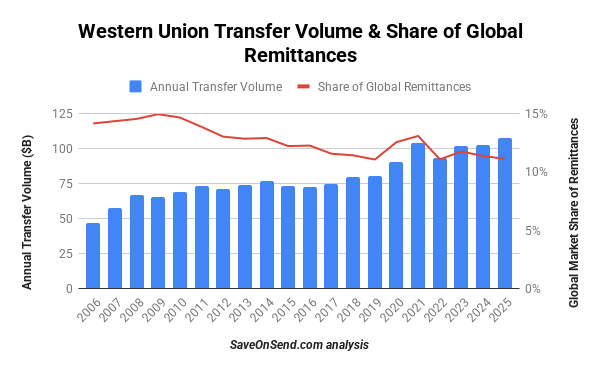
Western Union has more than doubled its transfer volumes since the early days of Xoom (the original fintech for remittances). However, this growth wasn’t sufficient to keep pace with the expanding market, leading to a gradual erosion in its market share of remittances over almost two decades:
Another sign of the collective impact as fintechs achieved scale is the decline in incumbents’ margins, commonly known as the “take rate.” Before fintechs reached scale in 2020, incumbents paid little attention to this aspect. Here’s how the CEOs of Western Union and Euronet (the parent company of Ria Money Transfer) described the competitive pricing environment in 2018:
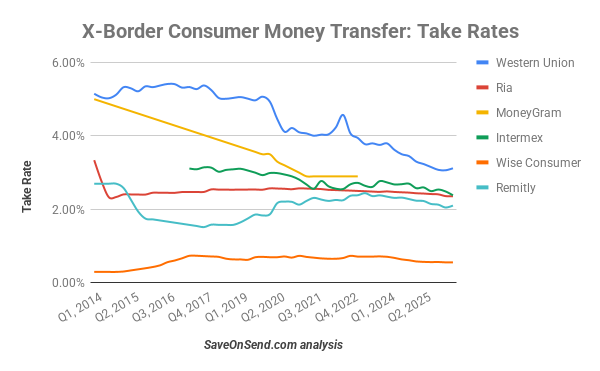
In 2020, Western Union’s margin declined by over 20%, falling from around 5% to less than 4%. This was driven in part by price reductions and the gradual expansion of the share of less expensive digital transfers. Other incumbents also reduced their margins, while those of Wise and Remitly remained relatively stable:
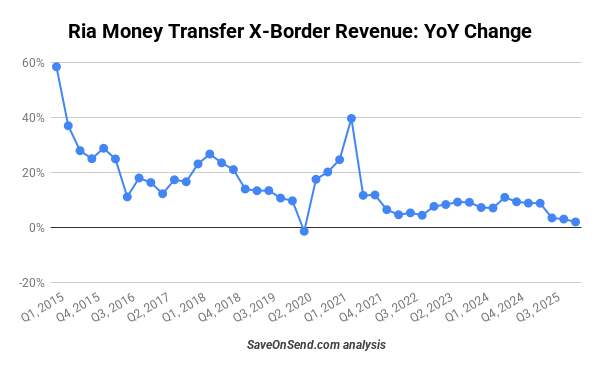
The second-largest incumbent, Ria Money Transfer, has also not experienced disruption yet, but its revenue growth rates, which were previously around 20%, have now disappeared:
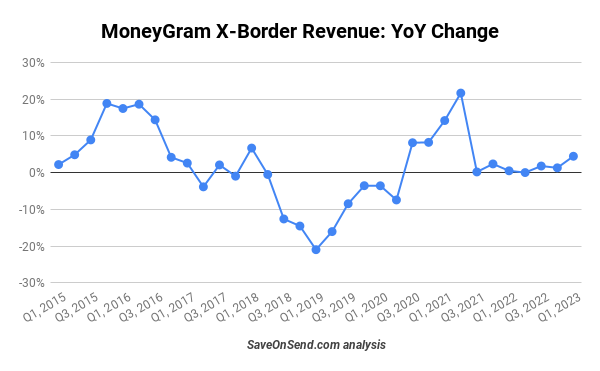
MoneyGram, once the second-largest incumbent in the industry after Western Union, is now stable but grappling with a lack of growth after a near-death experience in 2019 (as discussed in this SaveOnSend article).
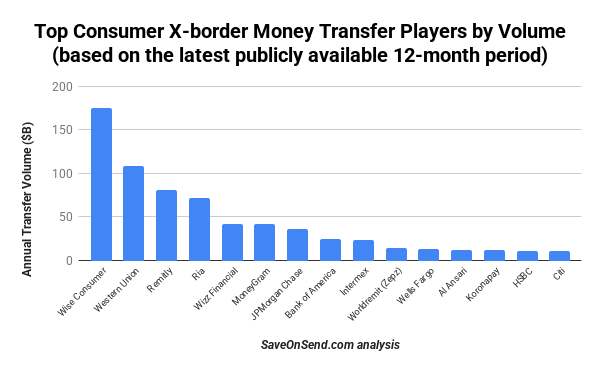
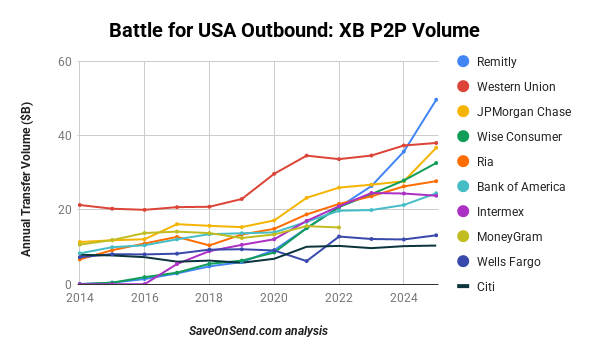
In addition to traditional money transfer operators, banks play a significant role in cross-border money transfers. Consumers in the US send more than $100 billion annually via banks. Banks have yet to experience disruption and have nearly doubled their transfer volumes in the last decade (for more information, refer to this SaveOnSend article). The largest consumer bank in the US, JPMorgan Chase, has remained among the top 3 players. By 2025, Remitly had become the undisputed leader in the world’s largest outbound market, ahead of both Western Union and JPMorgan Chase.
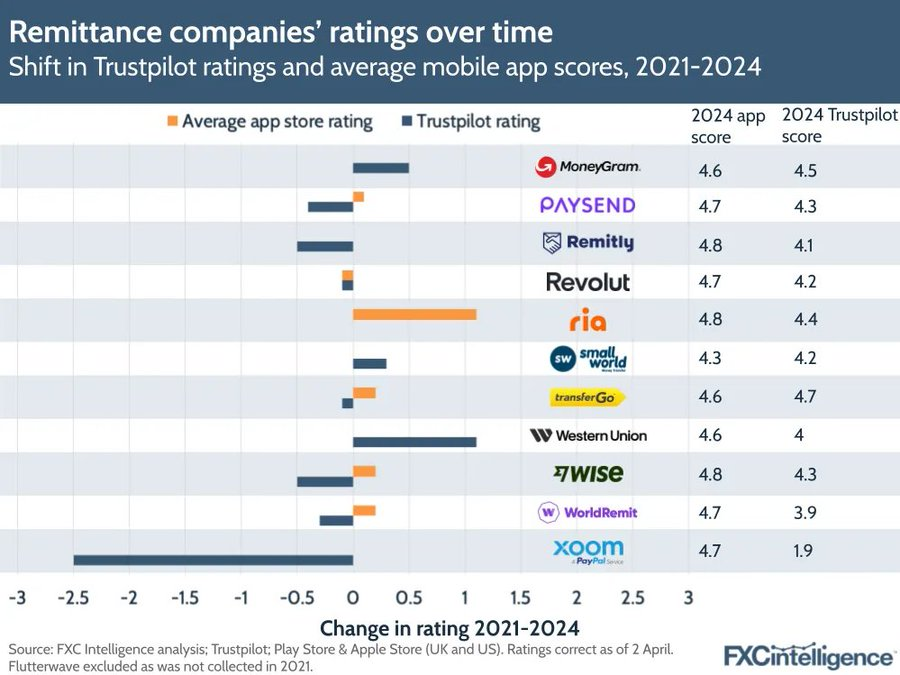
The lack of disruption so far is partly because traditional players haven’t stood still. They are typically slower than fintechs to launch new features, but eventually catch up by watching startups and copying what works. For example, between 2021 and 2024, the Trustpilot rating of traditional players has improved, while that of fintechs has declined, making the two groups indistinguishable regarding customer satisfaction:
Money transfer funding and valuation
The appeal of disruption and the substantial assets held by VC firms ensured an abundance of capital available to fintechs in this space. Between 2010 and 2019, just four startups attracted over $1.5 billion in funding:
As is customary with faster-growing fintechs, they command higher valuation multiples. For instance, the valuations per unit of transfer volume for Wise and Remitly are two to four times higher than those of Western Union and Intermex:
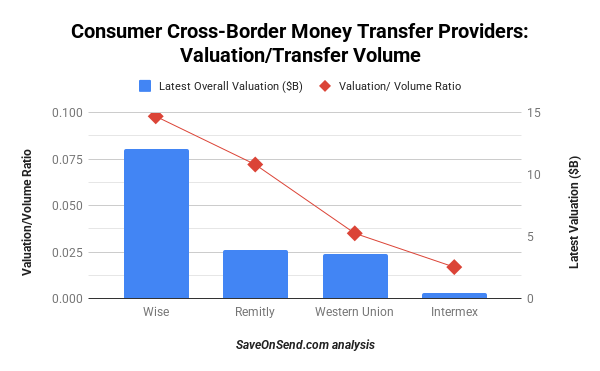
While incumbents’ volumes haven’t been disrupted yet, Wise and Remitly, which didn’t exist before 2011, are now valued much higher than Western Union. Investors are clear about which types of companies have much higher potential in cross-border consumer money transfers.
Performance differences across fintechs
After a couple of years, investors began distinguishing fintechs by performance quality, including their business, operational, and technological models. When examining the speed and scale of funding rounds from their launch, Wise had significantly outpaced the competition by Year 3. Remitly and WorldRemit were striving to keep pace with varying degrees of success, while Azimo never entirely gained traction:
By September 2018, Remitly had reached $6 billion in annualized transfers. While this might appear substantial, it paled in comparison to TransferWise’s growth trajectory. Both companies were founded around the same time and received their first $1 million+ in funding in April 2012. However, TransferWise reached a $2 million monthly transfer volume just a year later, more than two years ahead of Remitly. By mid-2015, TransferWise was transferring thirty times more per month than Remitly:
The underlying reason is in Remitly’s much slower scaling. In the first three years after Remitly was launched, the fintech served only one corridor: USA-to-Philippines. In February 2015, Remitly launched the second corridor, USA-to-India, and in October 2015, the USA-to-Mexico corridor. In July 2015, Remitly also announced its first acquisition of a failing application, Talio, to bring in local talent (both companies are based in Seattle) and beef up messaging features in Remitly’s mobile technology. In April 2016, Remitly opened an outbound business from Canada to India and the Philippines. In September 2016, the startup added seven more countries in Latin America for transfers from the US:
In early 2017, Remitly expanded its services to include a couple of outbound corridors from the UK. Given the excitement surrounding the digital remittances niche, it was not surprising that in the October 2017 funding round, Remitly was valued at “at least” $345 million.
Remitly utilized the funding to expand into new markets, such as Australia, in May 2018. By July 2019, Remitly had operations in 16 countries and had surpassed $2 billion in quarterly transfer volume:
Remitly’s deliberate scaling strategy has an irony: its famous founding story came from Kenya, where Matt Oppenheimer wanted to help a family put its child through school. Yet Remitly didn’t start in Kenya; it launched in the Philippines and then focused on major corridors like India and Mexico. The mission story came from Kenya, but the scaling strategy followed corridor economics.
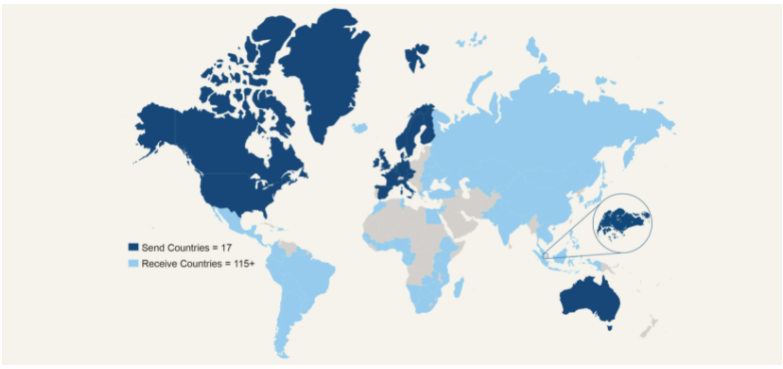
While Remitly’s progress is commendable, TransferWise’s rapid expansion overshadows it. TransferWise launched hundreds of corridors in the first four years, reaching $1 billion in transfers within its first 12 months in the US alone. By mid-2019, TransferWise handled seven times more volume than Remitly, with only 60% more employees. By 2021, TransferWise had expanded to cover over 40 outbound countries.
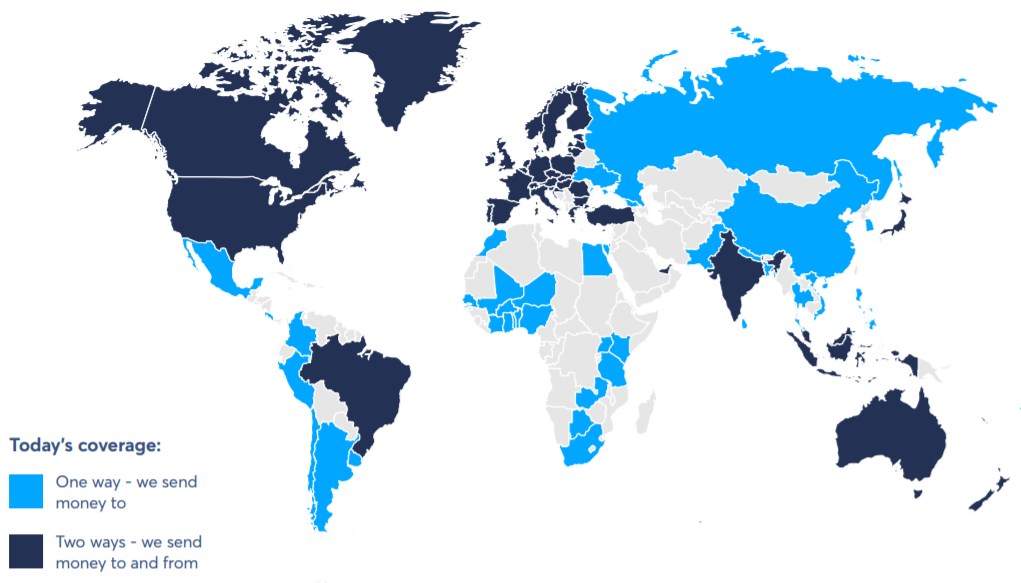
… while Remitly covered only 17:
Wise now handles more than twice Remitly’s consumer cross-border volume, but the comparison is not entirely apples-to-apples: Wise primarily competes for bank cross-border customers, while Remitly remains much more concentrated on traditional remittances. Wise is still growing consumer volume around the mid-20s at more than twice Remitly’s consumer scale, while Remitly had sustained roughly 35–40% volume growth until its recent slowdown.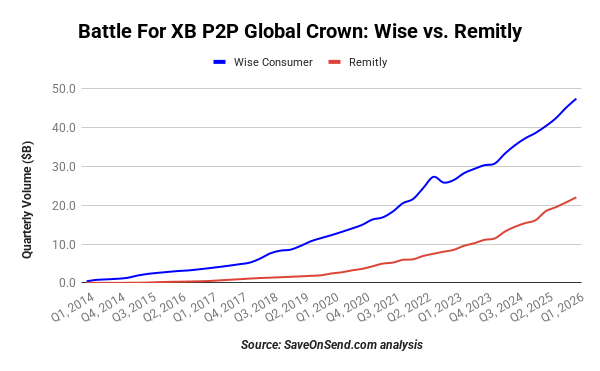 Wise has historically attributed roughly 70% of customer acquisition to word of mouth, although its paid engine has become increasingly important: marketing and sales reached about 9% of transaction revenue in FY26, still less than half of Remitly’s roughly 20%.
Wise could theoretically increase its marketing spend if its volume growth rate starts slipping below 20%. Remitly historically sustained roughly 35-40% volume growth by spending close to a quarter of revenue on marketing. In 2025, it cut that ratio to 21% and finally reached profitability, 14 years after launch. The growth trade-off is now becoming visible: send-volume growth fell from 40% in Q2 2025 to 27% in Q2 2026, the first time in Remitly’s history it dropped below 30%, while revenue growth fell from 34% to 20%.
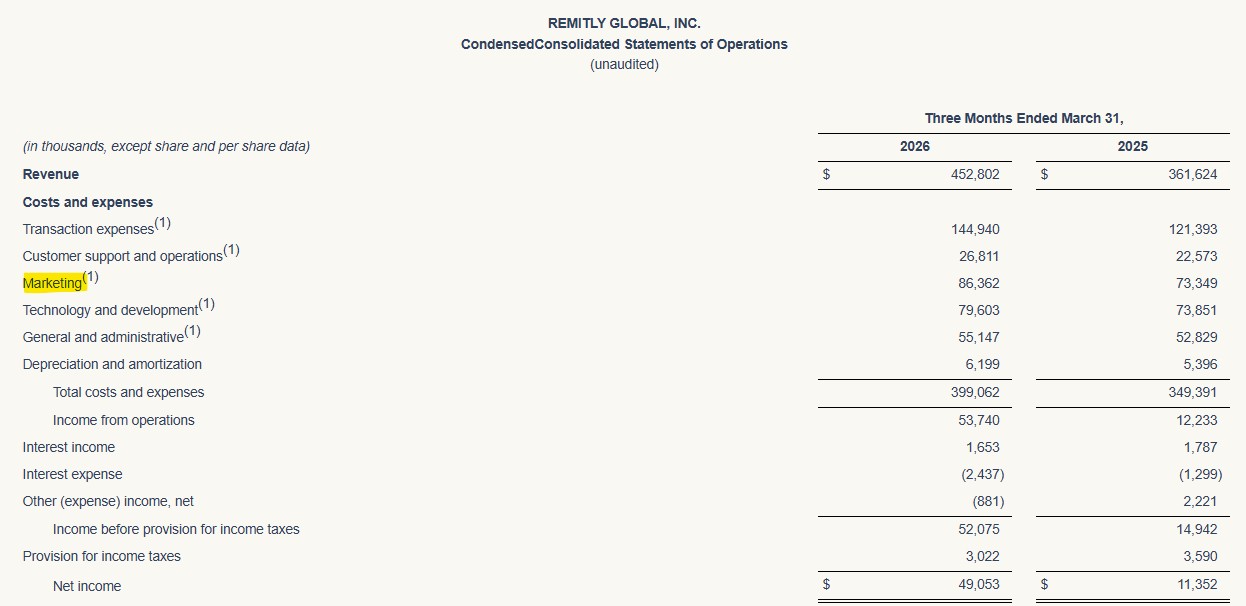
That shift appears increasingly deliberate. Before handing the CEO role to Sebastian Gunningham, Matt Oppenheimer reset Remitly’s medium-term ambition toward roughly 20% revenue growth and much higher margins. Gunningham has since emphasized cost discipline, smaller teams, and AI-driven operating leverage. Remitly may have won the US outbound market just as management decided that maximizing growth was no longer the objective.
Yet the CEO succession was explicitly intended to accelerate Remitly’s evolution from remittances into a broader cross-border financial platform, drawing on Gunningham’s Amazon experience scaling marketplaces and payments. Six months in, the clearest result is much higher profitability. Remitly Business is gaining traction, but Gunningham says the receiver flywheel is still “very early days” and “not proven,” while the Global Card has only just launched. The next race is whether these new businesses become material before the original remittance engine slows further.
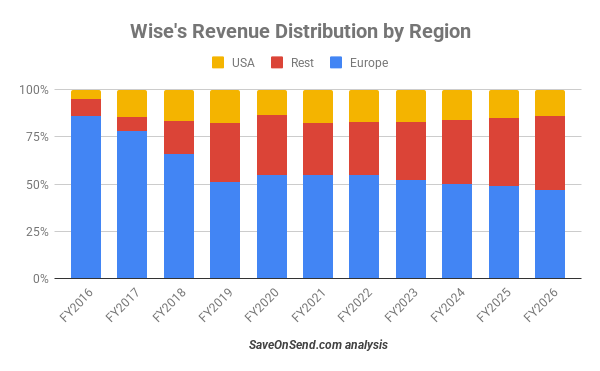
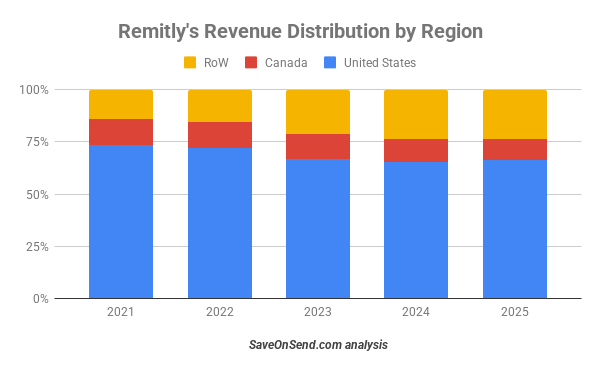
Wise’s larger transfer volumes and faster global expansion have resulted in more diversified regional revenue than Remitly. However, what’s notable in recent years is how stable these regional splits remain at scale, even as both fintechs continue to grow by 20-30%.
Why do money transfer fintechs fail?
A successful fintech typically takes five years to achieve profitability, requiring hundreds of millions of dollars in interim investments to acquire millions of customers. VC firms step in to bridge this cash-flow gap. Given that most fintechs fail, VCs are only willing to take such significant investment risks if they believe the fintech can become a market leader, at least in one large region. Remitly was primarily seen as a player in the US outbound market, WorldRemit in the Africa inbound market, and Wise in the Europe outbound market. Africa shows how large regional leadership can become: Zepz (WorldRemit + Sendwave) now appears roughly Western Union-sized in Africa, while LemFi has built another multi-billion-dollar remittance franchise.
Focus does not necessarily mean geographic narrowness. Wise expanded across hundreds of corridors much faster than Remitly and still became the larger player. The relevant question is whether each new corridor compounds the same customer and economic engine or forces the company to solve acquisition, pricing, and retention almost from scratch. Remitly went deep before broad, optimizing repeat usage, CAC, and LTV in a few enormous corridors before repeating the model elsewhere; Wise paired much faster expansion with an unusually efficient referral engine. The weaker fintechs below struggled to build the same compounding economics before their growth slowed.
Unfortunately for Azimo, it began operations a year after Wise with a similar regional focus. While its customer base comprised blue-collar migrants, Wise’s remarkable growth, compared to its focus on white-collar expats, indicated to investors that all types of cross-border consumers would eventually be interested in its service.
However, Azimo’s slower growth compared to Wise wasn’t solely due to the one-year lag. It was also attributed to less capable leadership, although the comparison was against an extremely high bar. Unlike Wise and Remitly, which achieved comparable success, the Azimo founders appeared more inclined to speak at conferences about their achievements and to make unsupported statements about the imminent disappearance of offline channels. In the end, they overestimated how quickly the digital migration wave itself would solve customer acquisition.
Even more unusually, the lack of intensity showed up when Azimo openly discussed its desire to be acquired as early as 2015, just three years after launch. Azimo’s less competent management team and lower intensity relative to leading fintech competitors were further hurt by the sudden 2017 exit of a co-founder, whom employees described as the “heart and soul of the place.”
The strategic problem was visible in Azimo’s own description of the business. In 2017, CEO Michael Kent acknowledged that Azimo had “less of a specific focus” than US competitors: no corridor represented more than 10% of its flow, leaving its business spread “portfolio-like” across numerous European migrant communities. Remitly did the opposite, concentrating resources on a few enormous US corridors and managing acquisition, pricing, and retention at the corridor level. Like Xoom, Azimo also limited its growth ambitions to one outbound geography (in Azimo’s case, Europe, whereas for Xoom, North America for the first decade).
As a result, Azimo’s growth slowed down to 25% by 2020, even as expenses increased by 50%:
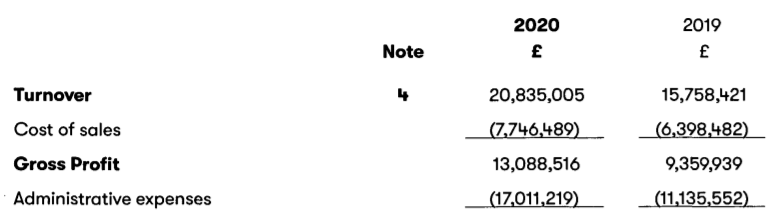
While investors were willing to provide hundreds of millions of dollars to Wise, Remitly, and WorldRemit, Azimo’s final funding round in May 2018 amounted to only $20 million, and the underlying valuation wasn’t disclosed. In early 2022, a payroll payments company acquired Azimo at a valuation similar to its 2018 round.
TransferGo and WorldRemit (Zepz)
A somewhat similar fate met another Europe-based startup, TransferGo, although it is still in operation. The startup was founded a year after Wise by Lithuanians who openly admitted they were trying to clone their Estonian competitor. While Wise was small enough and the market was expanding, TransferGo managed to grow rapidly, with a 100% growth rate in 2018:

By 2021, TransferGo’s growth had slowed to 25%, with only $6 billion of cumulative volume over almost a decade. Remitly was already transferring $6 billion annually three years earlier, while Wise had crossed $6 billion of cumulative volume in 2015. TransferGo Holdings lost £15 million before tax on £27 million of revenue in 2022, £5 million on £41 million in 2023, and £11 million on £45 million in 2024. Twelve years after launch, TransferGo still operated at a fraction of Wise or Remitly’s scale, without a durable profit engine, even as it raised another $10 million in 2024. By 2025, TransferGo’s UK subsidiary was generating only £39 million in revenue and incurring a £2 million pre-tax loss. Even its brief profitability in 2024 depended on £11 million of other operating income from a transaction with a sister company.
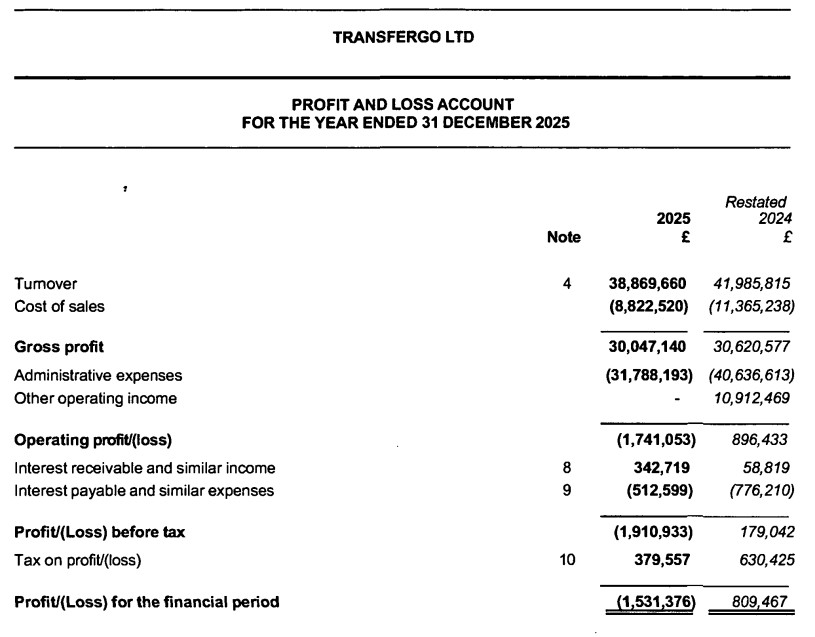
Source: Companies House
WorldRemit (aka Zepz) falls into a middle-ground category, being more successful than Azimo but trailing behind Wise and Remitly. The underlying reason for its lower valuation compared to the leading fintechs is essentially the same: relatively weak planning and execution. For instance, in 2015, WorldRemit significantly overestimated its growth rate across markets, leading to employee layoffs in the US and the UK.
In 2017, WorldRemit was eager to expand in the US and drastically cut prices by two-thirds in its two top corridors, resulting in a loss of approximately 0.5% per transaction. However, realizing that this strategy wasn’t working or sustainable, WorldRemit eventually raised its prices back to previous levels:
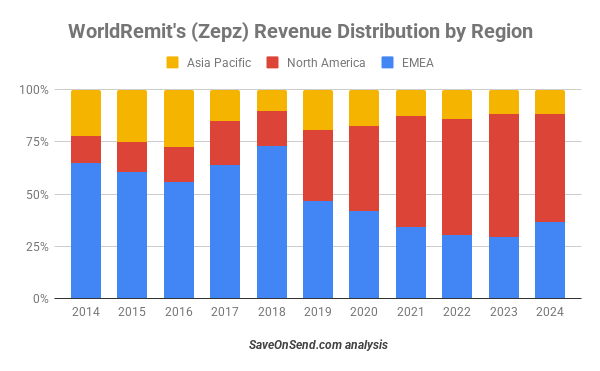
Mistakes in regional expansion cost years of hard work and left its combined market share outside Europe lower in 2018 than in 2014, only starting to recover afterward. In 2020, WorldRemit agreed to buy Sendwave near the peak of the Covid digital-remittance boom to acquire a fast-growing, app-only franchise in North America-to-Africa corridors. The deal was marketed as a scale step-change: WorldRemit and Sendwave claimed roughly $7.5 billion in transfers and $280 million in LTM revenue at announcement, and the combined company later said it processed about $10 billion in transfers in 2020.
This growth did not translate into durable profitability: losses remained large after the deal, and by 2024 Zepz was explicitly prioritizing sustainable growth, cost reduction, consolidation of WorldRemit and Sendwave, and lower headcount. Ironically, the retrenchment was most visible in the Americas, the region Sendwave was acquired to strengthen: Americas transaction revenue fell from $166 million to $75 million in 2024, even as other revenue partly offset the decline.
WorldRemit’s uneven management also led to forecasting misses. In June 2015, its founder & CEO expected to triple 2015 revenue compared to 2014. In November, WorldRemit downgraded expectations to “at least double” and finished 2015 with an 80% growth.
WorldRemit also underperformed in developing a scalable business model. A company growing by 50% should be enjoying rapidly increasing operating margins. However, WorldRemit doubled its losses between 2017 and 2018:
What was even more uncharacteristic for a near-unicorn fintech is that to address its management deficiencies, WorldRemit was spending millions on management consultants, tripling the spending to $8.5 million in 2018:
More fundamentally, WorldRemit faced a dilemma similar to Remitly’s until 2021: it was growing rapidly but remained unprofitable, spending almost 25% of revenue on marketing. In 2022, under investor pressure, WorldRemit had to cut marketing spending to 13% of revenue. Not surprisingly, that resulted in a collapsing growth rate of just 14%. Its 2023 performance was even worse, with 5% revenue growth on only 11% volume growth and rapidly expanding operating and income losses.
By 2024, WorldRemit had effectively stopped pretending this was still a high-growth story. Revenue fell 10% and volume 8% as management aggressively cut costs and consolidated WorldRemit and Sendwave, reducing the net loss from $89 million to $31 million. In 2025, the send volume rose 20% to $18 billion while revenue fell another 5%, take rate dropped to 2.3%, marketing nearly doubled, adjusted EBITDA declined, and operating profit fell despite a major cost reset. Zepz had improved its survival odds, but it was still growing volume by giving up economics.
New players joining the consumer cross-border money transfer game
One might assume the competitive nature of consumer money transfers would dissuade other fintechs from entering the market. However, that hasn’t been the case. As Jim Barksdale, CEO of Netscape, famously said in 1995, “…there are only two ways I know of to make money: bundling and unbundling.”
Money-transfer fintechs illustrate the cycle particularly well. Xoom and Remitly unbundled Western Union, Wise unbundled banks, and once Wise and Remitly reached scale, a new generation began trying to unbundle them. In 2021, Revolut ventured into the world’s largest remittances corridor, from the US to Mexico (worth over $60 billion), by offering nearly free transfers with no foreign exchange markup to its customers:
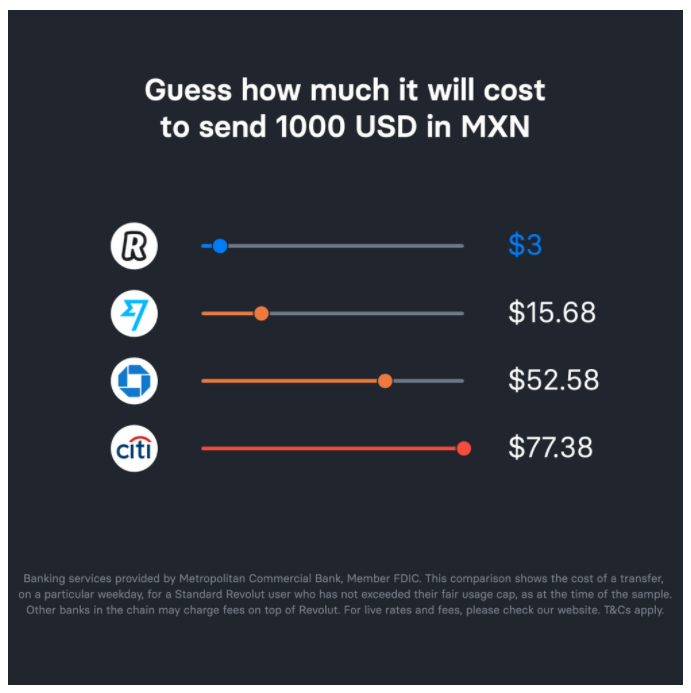
The impact was so strong that MoneyGram had to acknowledge it publicly:

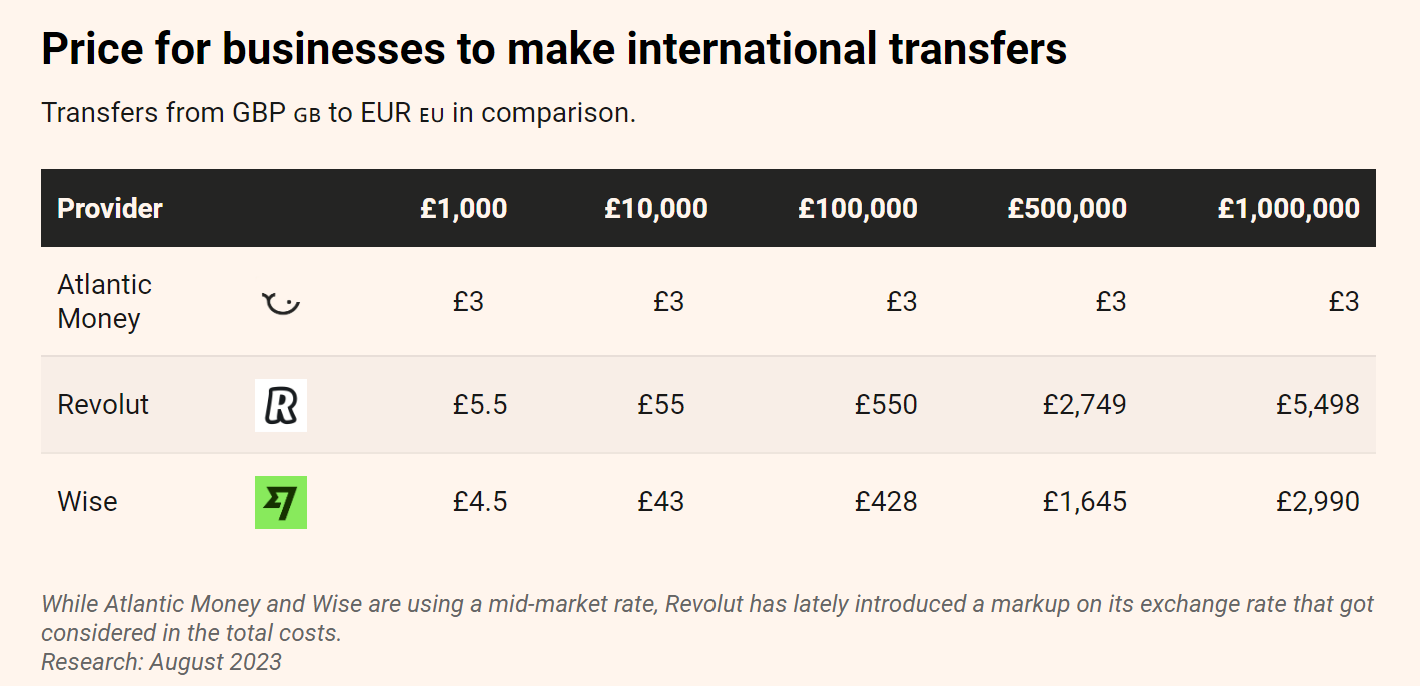
In 2020, former employees of renowned fintechs Robinhood and Tinkoff introduced Atlantic Money in the UK. Their marketing approach aimed to compete directly with Wise. Atlantic Money offered fixed-fee transfers for £3 or €3 at the prevailing exchange rate (eliminating foreign exchange markup):
After 1.5 years, Atlantic Money was running one year ahead of Wise, which passed the same £30M/month milestone around the 2.5-year mark. Additionally, Atlantic Money planned to expand to the US three years sooner. Its tiny fee and zero FX markup were naturally attracting higher send amounts:

Atlantic Money questioned the premise of variable costs for cross-border money transfers. Do the costs actually increase with larger amounts? And if they are more or less fixed, why should providers charge more depending on the amount?
An even more surprising entry came from HSBC’s subsidiary Zing. Launched in early 2024, Zing charges only 0.2% across all corridors with no additional fees and offers more lucrative promotions, including better referral bonuses than Wise. Despite the failure of similar efforts by BBVA (Tuyyo) and Santander (PagoFx), HSBC has wholeheartedly jumped into this highly competitive field, and no less than on the home turf of intense players like Wise, Revolut, and Atlantic Money. True to its scale, HSBC launched Zing with a massive group of 80 employees, supporting transfers in dozens of currencies.
While great for consumers, such intense price competition has raised concerns about the sustainability of new entrants’ business models. It took Wise six years to reach profitability and Remitly 14. However, Atlantic Money and HSBC’s Zing were charging much less than these leading fintechs, putting additional pressure on margins and long-term viability. Indeed, by late 2024, a payroll platform had acquired Atlantic Money, and by early 2025, HSBC had shut down Zing.
The pattern continues. In 2026, African fintech giant Moniepoint shut its UK-to-Nigeria MonieWorld service just 18 months after launch, despite its enormous Nigerian payments network and an original ambition to become a top-two provider in the corridor. Like two decades ago, fintechs still go after remittances, underestimating incumbent competition, compliance, and the difficulty of making LTV/CAC work at scale. In that context, having the last mile is only a minor advantage.
More recently, Félix found a genuine remittance innovation in WhatsApp, helping it reach roughly a $5 billion annual run rate in only five years, about a year faster than Remitly. By September 2026, Félix said it had processed more than $8 billion across 11 Latin American markets. Yet its growth has already slowed from roughly 5x to 3x to less than 2x as its referral-, partnership-, and promotion-heavy acquisition engine becomes progressively harder to compound.
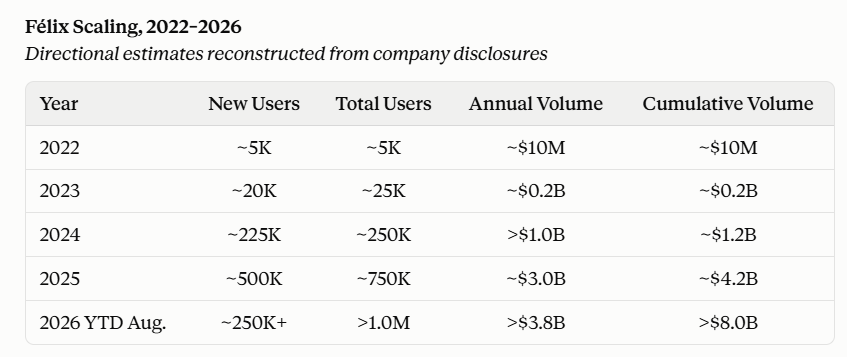
Stablecoins are genuinely part of its backend: U.S.-Mexico has been documented as USD → USDC → Bitso → MXN → domestic payout, and Félix is building multi-issuer settlement optionality. But it has not disclosed what share of transfers actually uses stablecoins, while conventional processors, MTOs, treasury, FX liquidity, and local payout networks remain essential.
More importantly, the promised stablecoin cost advantage does not consistently reach customers: Félix still charges explicit fees plus an exchange rate that can contain a markup and has repeatedly been beaten by conventional MTOs in Mexico. Its clearest quantified infrastructure improvement in 2026, a 50% reduction in payment latency, came from insourcing conventional payment orchestration.
Aspora has scaled even faster, reaching close to $0.5 billion in claimed monthly volume after roughly three years, near Wise’s early pace and well ahead of Remitly. But the evidence that stablecoins explain that growth is much weaker. Aspora raised $93 million in six months while offering Google-rate, zero-fee transfers; focusing on digitally banked NRIs; using regulated partners and banks for execution; and planning to monetize the relationship through banking, investments, and other financial products. Stablecoin use is handled through payment partners, with no public disclosure showing what share of Aspora’s transfers actually moves on-chain or how much stablecoins contribute to its economics.
The disruption in international money transfers never seems to stop, so let’s stay alert for more surprises:
Banks ← Western Union ← Xoom ← Wise / Remitly ← Aspora / Felix ← Who is Next?
Conclusion
Two decades of money-transfer fintechs show that digital distribution alone was never enough to disrupt incumbents. Western Union, Ria, MoneyGram and banks proved far more resilient than expected, while most fintech challengers ran out of momentum before reaching sufficient scale and durable economics. Wise and Remitly were the exceptions, attacking different halves of the consumer cross-border market with very different models. Wise primarily attacked banks’ cross-border transfer customers. Remitly primarily attacked traditional MTO customers, effectively as a better mobile-native evolution of Xoom. Both nevertheless developed customer-acquisition and operating engines that kept compounding long after the initial digital migration wave.
That is the race against time. VC funding can finance years of losses, but eventually a fintech must prove that additional customers, corridors, and volume strengthen rather than overwhelm its economics. Azimo failed that test, TransferGo remains subscale, and WorldRemit spent years repairing the consequences of weaker execution after reaching substantial scale. Félix and Aspora are now running the same race at exceptional early speeds, with Félix reaching Remitly-like scale about a year faster; whether they can sustain those economics is the next test.
As with all our analyses, if you encounter any errors or believe we’ve missed essential perspectives in this article, please don’t hesitate to comment below. We value your feedback and will continually update this post, so check back soon for more insights!