
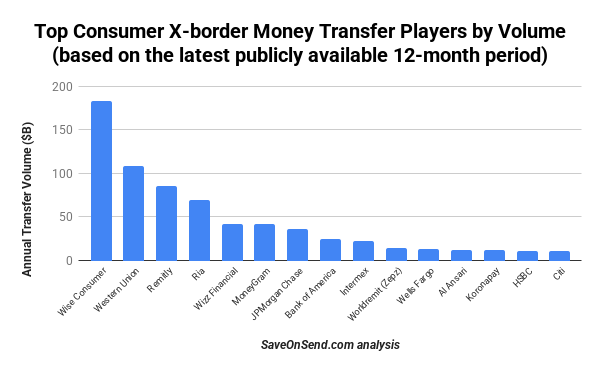
Why did Wise and Remitly become global leaders while most money-transfer fintechs stalled or disappeared? Why do banks still handle roughly 40% of U.S. outbound consumer volume despite weaker pricing and digital products? Why does cash remain important after a decade of rapid digital adoption? What actually determines whether a new corridor, technology, or business model improves economics? And do stablecoins solve a meaningful part of cross-border transfers, or mostly replace one piece of the plumbing?
Those are the kinds of questions we investigate at SaveOnSend: how consumers actually behave, how providers really make money, and why the industry often evolves very differently from the disruption stories told about it.
SaveOnSend is an independent research publication focused on consumer cross-border money transfers. We analyze market structure, provider economics, consumer behavior, pricing, banks, fintechs, remittances, crypto and stablecoins, with an emphasis on evidence that separates durable business-model change from industry narrative.
Our research is written for investors, executives, journalists, researchers, founders, and industry practitioners who need a fact-based view of how this market actually works.
Why SaveOnSend exists
SaveOnSend began because the consumer cross-border money-transfer market was full of misleading claims and weak analysis, and we couldn’t find a high-quality source of fact-based, independent research on how consumers, providers, and the industry actually behaved.
SaveOnSend.com was initially only a comparison site, or, as we liked to say back then, “a kayak for remittances.” However, after the first couple of months in early 2015, it became evident that most of what we knew about this space was wrong. For example, we quickly discovered that even low-income consumers aren’t that eager to save a few dollars per transfer; they don’t really mind going to a cash agent, and large providers aren’t much more expensive than Fintech startups. At about the same time, or shortly after SaveOnSend’s launch, many similar and more advanced comparison sites launched: CompareRemit, Monito, RemitRadar, etc. In December 2018, Monito became the first comparison site to raise a $2.5 million funding round.
Since consumers didn’t really care for our comparison services, we wanted at least to share our learnings with the world and learn more in the process. That’s how SaveOnSend’s research publication began. At first, few people paid attention until Tim Swanson shared our article on Bitcoin/Blockchain money transfers. Tim is one of the world’s top experts on distributed ledgers for back-end financial services, and SaveOnSend’s blog got on the map.
Over the years, we made plenty of wrong conclusions. We were skeptical about Bitcoin’s use in money transfers, but even that view was too optimistic. We didn’t think Wise would break even, or that Remitly or WorldRemit would keep growing by 50+% for so many years. We were surprised by the banks’ large share in cross-border money transfers and by the continued growth in their volumes. We didn’t think that Western Union could slow down so much… with many more examples like that. But our daily research, conversations with consumers, and feedback from our readers in the money transfer industry helped us quickly learn and revise our perspective.
SaveOnSend’s published research is independent of the companies and products it covers. No company can pay for inclusion, placement, or favorable treatment in the articles published here. We follow the evidence, update our views when better data emerge, and publish the conclusions that evidence supports.
We start with the claim, ask what evidence would prove or disprove it, and compare it with the strongest alternative explanation. We distinguish reported facts from inference, prefer operating and economic outcomes over proxies, and revise our conclusions when better evidence emerges.
What to expect from SaveOnSend
SaveOnSend started as a consumer comparison service, but evolved into independent research on how the consumer cross-border money-transfer industry actually works.
We study consumers, providers, banks, fintechs, pricing, technology, regulation, acquisition, operating models, and economics. The recurring question is the same: what actually creates better outcomes for customers and durable economics for providers, versus what merely sounds disruptive?
Our articles are living analyses. We update them as companies report new numbers, technologies move from pilots into production, and new evidence proves our earlier conclusions right or wrong.
Our research covers industry structure and economics; Western Union, MoneyGram, Wise, Remitly and other major providers; banks and specialist MTOs; pricing and FX; consumer behavior and migration; fintech scaling and operating models; customer acquisition; compliance, fraud, liquidity and payout networks; digital versus cash channels; and crypto and stablecoins as payment infrastructure.
Contribute evidence
If we got something wrong, show us. If you have better data, a filing we missed, first-hand operating evidence, or a credible argument that contradicts one of our conclusions, email us at admin@saveonsend.com. We will investigate it and update the article when the evidence warrants it.
We are especially interested in evidence that is hard to find publicly: actual transfer volumes, customer behavior, pricing, unit economics, operating costs, corridor economics, technology performance, and what happened after the press release.
And if there is a company, claim, or industry narrative you think deserves the same treatment, tell us what to investigate next.