

“I think we will know when bitcoin has reached prime time when it is transferring more value each day than Western Union or Money Gram…”
Roger Ver, November 2013
Taxonomy:
- Crypto-native transfer: crypto at both ends.
- Stablecoin sandwich: fiat → stablecoin → fiat.
- Digital-dollar access: buying or holding stablecoins without transferring them internationally.
- Consumer remittance: an individual sends money to another individual.
- Business payment or treasury: companies move working capital, supplier payments, or FX liquidity.
- Wholesale settlement: regulated institutions settle obligations between themselves.
- Blockchain infrastructure: the ledger or messaging layer, regardless of the currency transferred.
Since the publication of “Bitcoin: A Peer-to-Peer Electronic Cash System” in 2008, international money transfers, although constituting a smaller portion of cross-border payments, have emerged as one of the most promising use cases for crypto.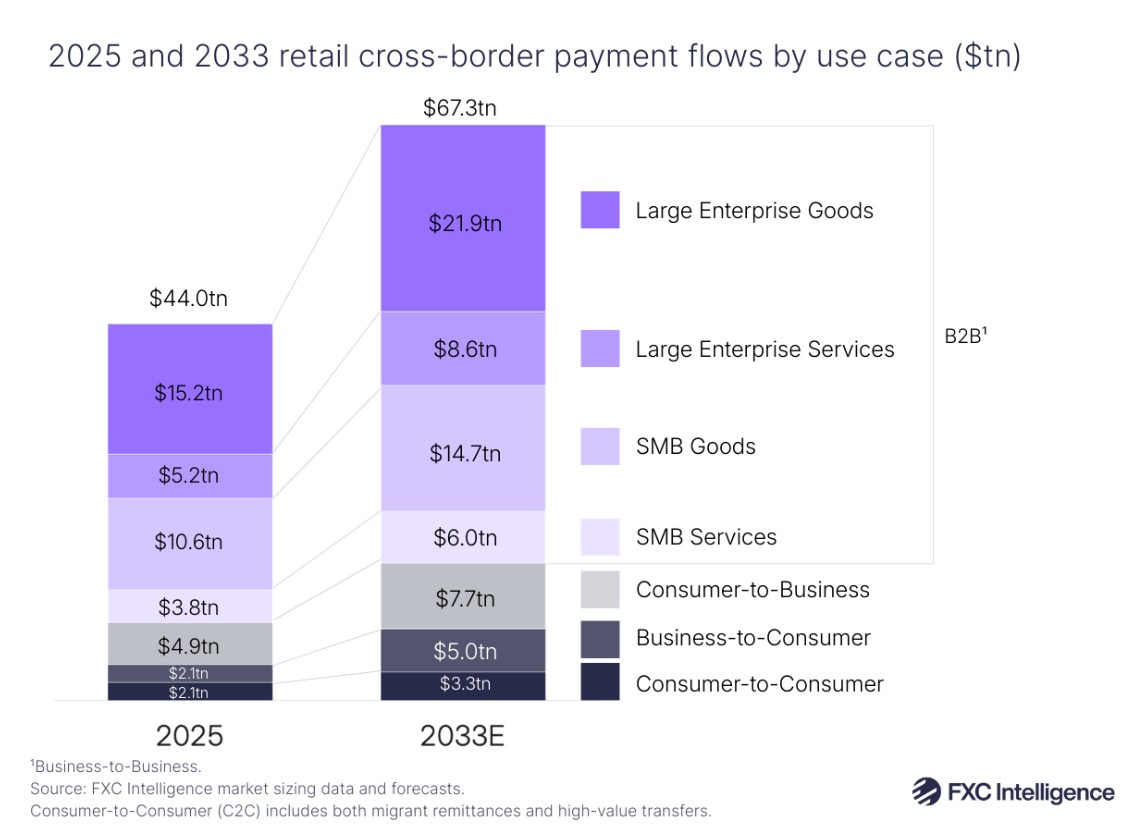
The original thesis was simple: remittance users paid high prices for slow, opaque service, while blockchain could move value almost instantly at negligible rail cost. Crypto founders and investors also framed it as a way to bypass banks and reach underserved recipients. Startups raised capital to test that thesis through consumer services and MTO partnerships. El Salvador later turned it into a national experiment by making Bitcoin legal tender and promoting it for remittances.
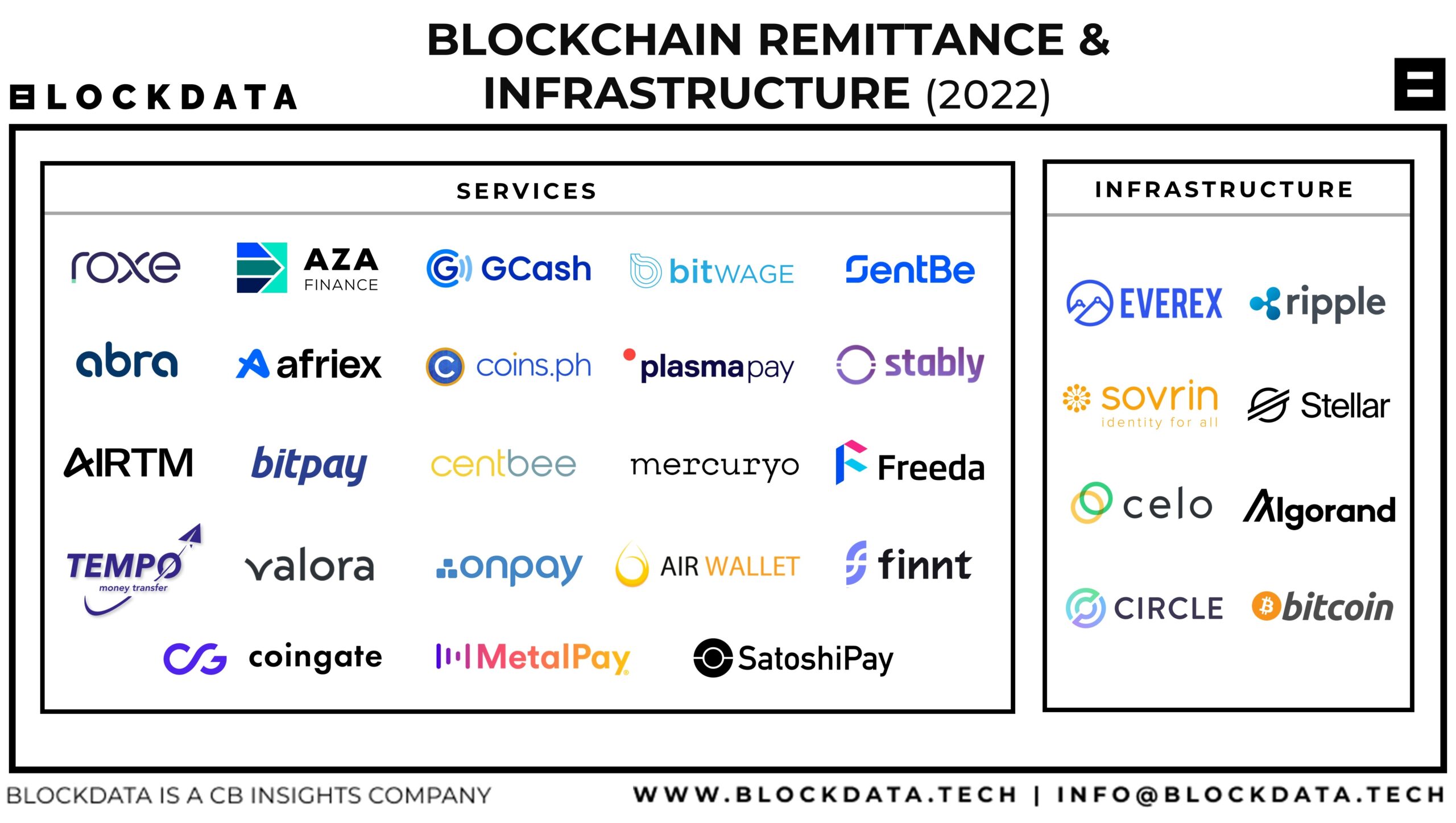
After more than a decade of pilots, crypto has not displaced conventional consumer remittance rails at a meaningful, independently verified scale. Stablecoins have nevertheless become a credible back-end option in select corridors and a useful instrument for digital-dollar access, treasury mobility, and certain high-friction cross-border flows. Most disclosed consumer-remittance implementations remain selective routes, subsidized programs, or company-reported deployments whose scale and unit economics are not independently verifiable.
The decisive question is therefore whether the full end-to-end system, including funding, FX, compliance, liquidity, payout, cash-out, support, fraud, and reversibility, beats modern fiat alternatives on price, speed, reliability, and scale. Public evidence remains strongest for digital-dollar access and some business or treasury use cases, and weakest for broad consumer-remittance transformation.
By 2025, stablecoins had moved from fringe remittance experiments into the product roadmaps of major consumer money-transfer providers. Western Union, Euronet, MoneyGram, Majority and Remitly announced stablecoin wallets, on- and off-ramps, disbursement capabilities or integrations into their existing cross-border networks. This marked an institutional turning point, although in 2025 it still mostly measured announced capabilities rather than consumer usage or transfer volume.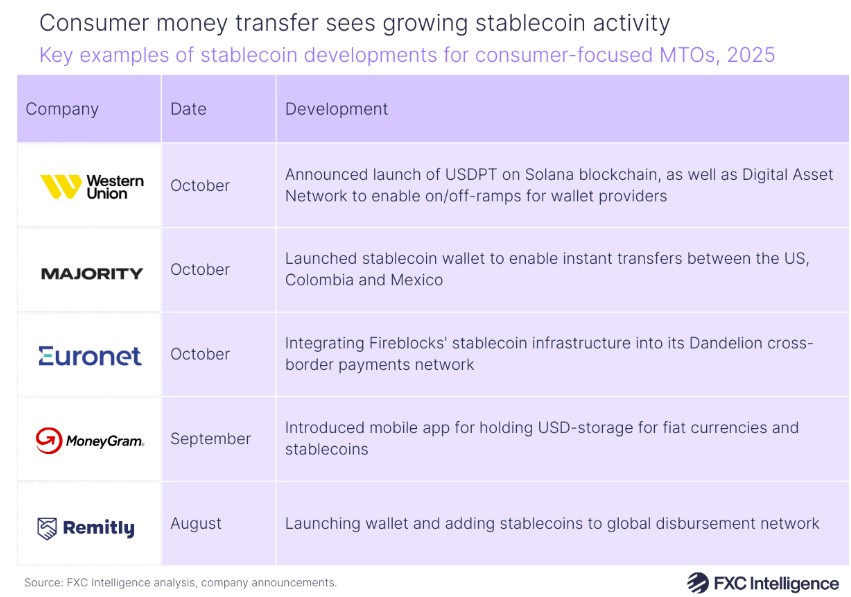
By mid-2026, several of those roadmaps had moved into production. Euronet launched stablecoin payouts; Western Union launched USDPT and Stablecard, with the latter live in 37 markets; MoneyGram launched MGUSD; and Remitly launched a stablecoin card and wallet in selected Latin American markets. This is stronger evidence of institutional adoption than the 2025 announcements. But the cited disclosures still do not quantify how much consumer-remittance volume actually uses stablecoin settlement or demonstrate a reduction in customers’ total fees and FX markup.
MoneyGram does disclose one measure of internal scale: its stablecoin FX trading runs at roughly $2 billion annualized. But that is treasury and FX activity, not disclosed consumer-remittance settlement volume or evidence of lower customer prices.
PYUSD provides an even cleaner warning against treating stablecoin circulation as payment adoption. Its first major boom came after PayPal launched on Solana in 2024, and PYUSD paid roughly 15–18% yields on Kamino and Drift; circulation crossed $1 billion, then fell sharply as those incentives faded. The pattern repeated at much larger scale in 2026. Around PYUSD’s $4.1 billion peak, Ethena alone held $1.13 billion and Aave about $445 million. PayPal then expanded PYUSD availability to 70 markets, explicitly promoting cross-border transfers and dollar access, yet circulation subsequently fell by roughly $1.3 billion as those large DeFi positions unwound.
A more revealing comparison is how leading digital remittance players actually reached scale. Wise and Remitly became global consumer remittance leaders by improving the entire P2P proposition: digital customer acquisition, bank funding, compliance, FX, risk management, and local payouts. They reached that scale before adding stablecoins, if they added them at all. Even in Africa, where stablecoins supposedly rule, Zepz (WorldRemit + Sendwave) and LemFi became two of the continent’s largest digital remittance players before adopting stablecoin infrastructure.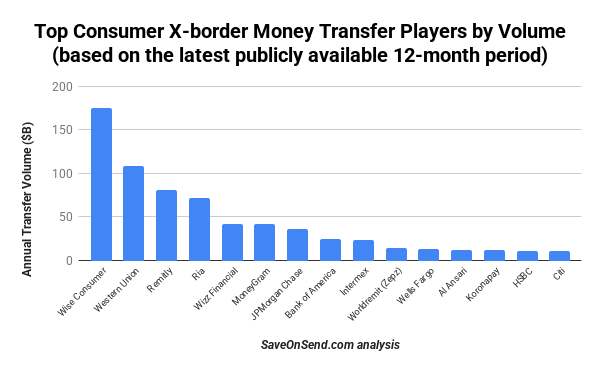
Innovation Adoption: 3 Cases
Stablecoins do not need to replace every remittance rail to become material. They need to win decisively in at least one of three ways: solve a customer problem incumbents leave unresolved, support a business model incumbents cannot match, or create new transfer demand. The rest of this article tests each path.
- Incumbents fail to address customer pain points (Blockbuster -> Netflix).
- Incumbents lack a scalable business model (Borders -> Amazon).
- Technology spawns entirely new demand (radio -> Spotify).
Is a significant segment of money transfer users suffering without crypto?
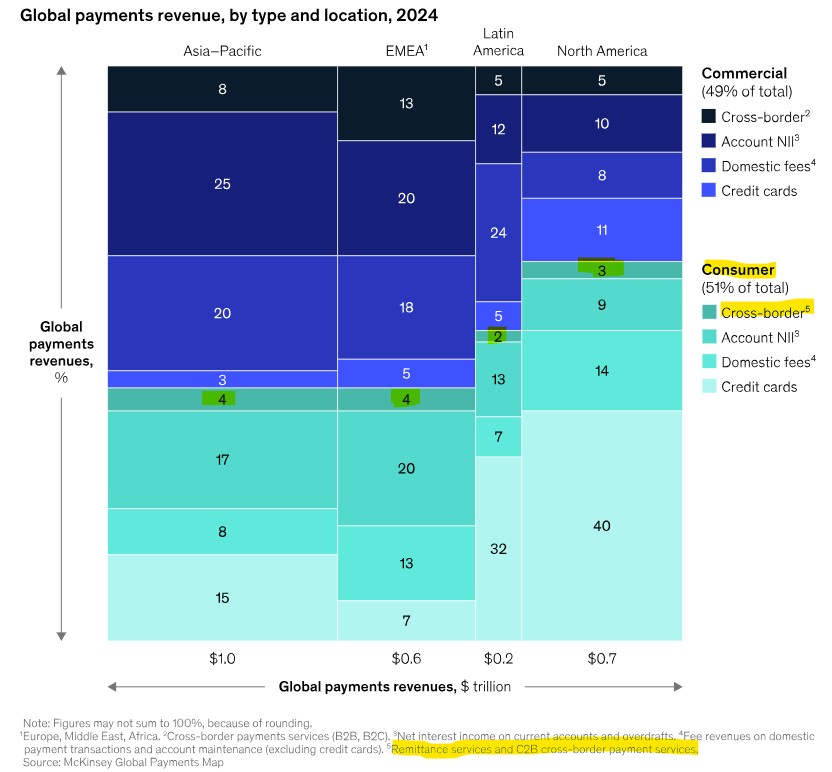
Articles titled “The Unexpected Tragedy Of The Financial System” have been prevalent for the past decade. These virtue-signaling stories often promote crypto as a way to help the poor in developing markets but lack field research or customer surveys. Consumers generate around $90 billion annually in payments-industry revenue from remittances, and C2B use cases like education. Remittances account for about half of that amount, and it would be neat to find a way to provide the same service while the industry earns much less.
In 2025, the CFPB closed 2,300 complaints involving international money transfers, compared with 5,200 involving virtual currency.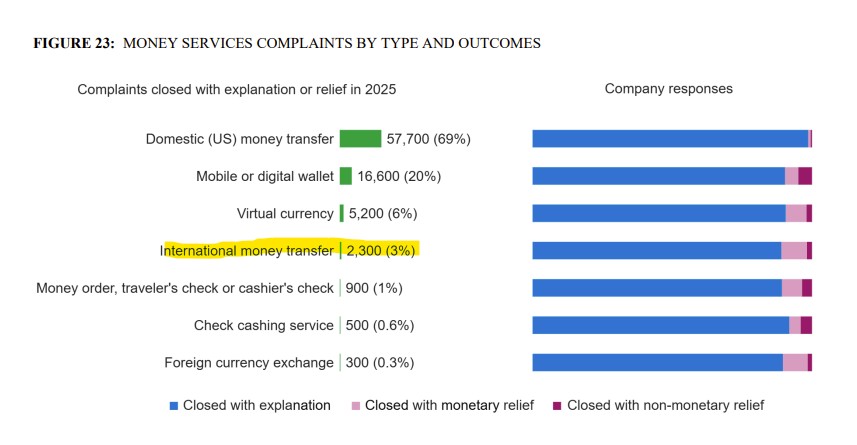
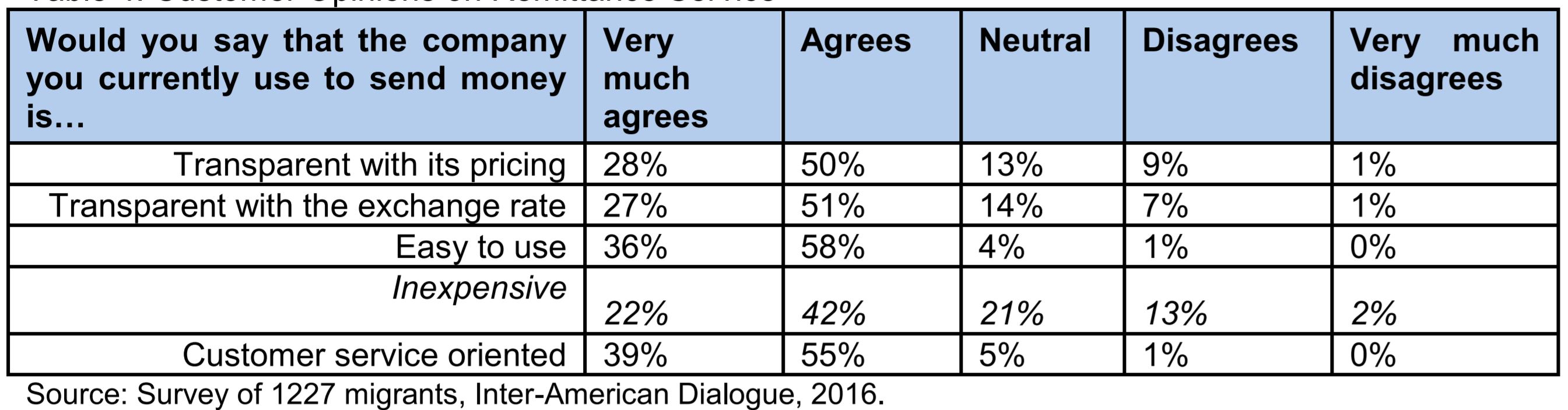
Conversations with enough low-income consumers who make international money transfers would reveal that no “tragedy” exists, as often portrayed. Even more perplexing, this segment doesn’t seem motivated to save on money transfers. In a 2016 survey, even before the fintech-driven price decline, only 15% of migrants believed their current provider was expensive.
A decade later, lack of technology is an even less convincing explanation for cash use. Treasury and the IRS estimate that only 7% of immigrants live in unbanked households, while smartphone and internet access are around 90% and 95%. Digital remittances have nevertheless taken a substantial share: by 2026, the Inter-American Dialogue estimated that 53% of Latin American remittance transactions were digital, compared with 47% in cash. That aggregate split also hides considerable switching between channels. The Dialogue found that remitters frequently alternate between cash and digital methods rather than consistently using one or the other:
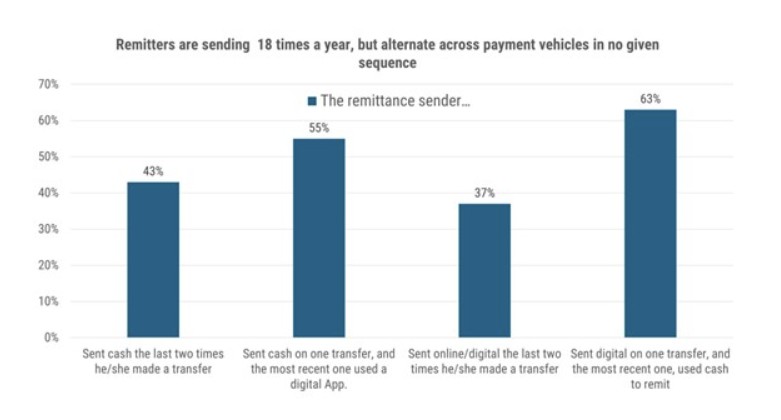
LAC remitters alternate between cash and digital channels, 2026. Source: Inter-American Dialogue
This switching also shows why “digital” origination can exaggerate how much behavior has actually changed. In Central America, half of remittances were still initiated and paid in cash in 2025, while only 9% were digital at both ends; the remainder used a mix of cash and digital channels. Treasury and the IRS similarly estimate that 30–36% of U.S. MSB remittances are still funded with cash. Consumers have adopted digital remittances, but cash remains remarkably persistent despite widespread access to cheaper digital alternatives.
Can crypto money transfers help the needy?
Crypto- or fiat-based fintechs focusing on money transfers often use narratives involving “unbanked,” “poor,” or “women” recipients of remittances in developing countries as their inception story. Consider a hunger-stricken woman with no financial accounts in a sub-Saharan village. We are asked to believe the founders are deeply concerned about improving her situation with their digital remittance solution. As with stories about the challenges remittance senders face, these startup founders have likely never encountered such a person. Their claims often lack specificity on how to target these segments and on the viability of generating revenue through such difficult targeting.
The argument that crypto remittances help unbanked consumers contains misconceptions about the sending and receiving ends of a money transfer. As we discussed earlier, most senders have both a bank account and a smartphone and are generally content with their cash-sending experience. However, the question arises: Why do they choose to send cash? Many consumers opt for cash transfers in specific corridors to avoid potential deportation and taxation issues. For smaller transfers, cash agents operate under much lighter practical identification requirements than bank-account and online channels; specific federal identity-verification and recordkeeping requirements for non-established customers kick in at $3,000.
Here’s how the CEO of a major traditional provider described this challenge:
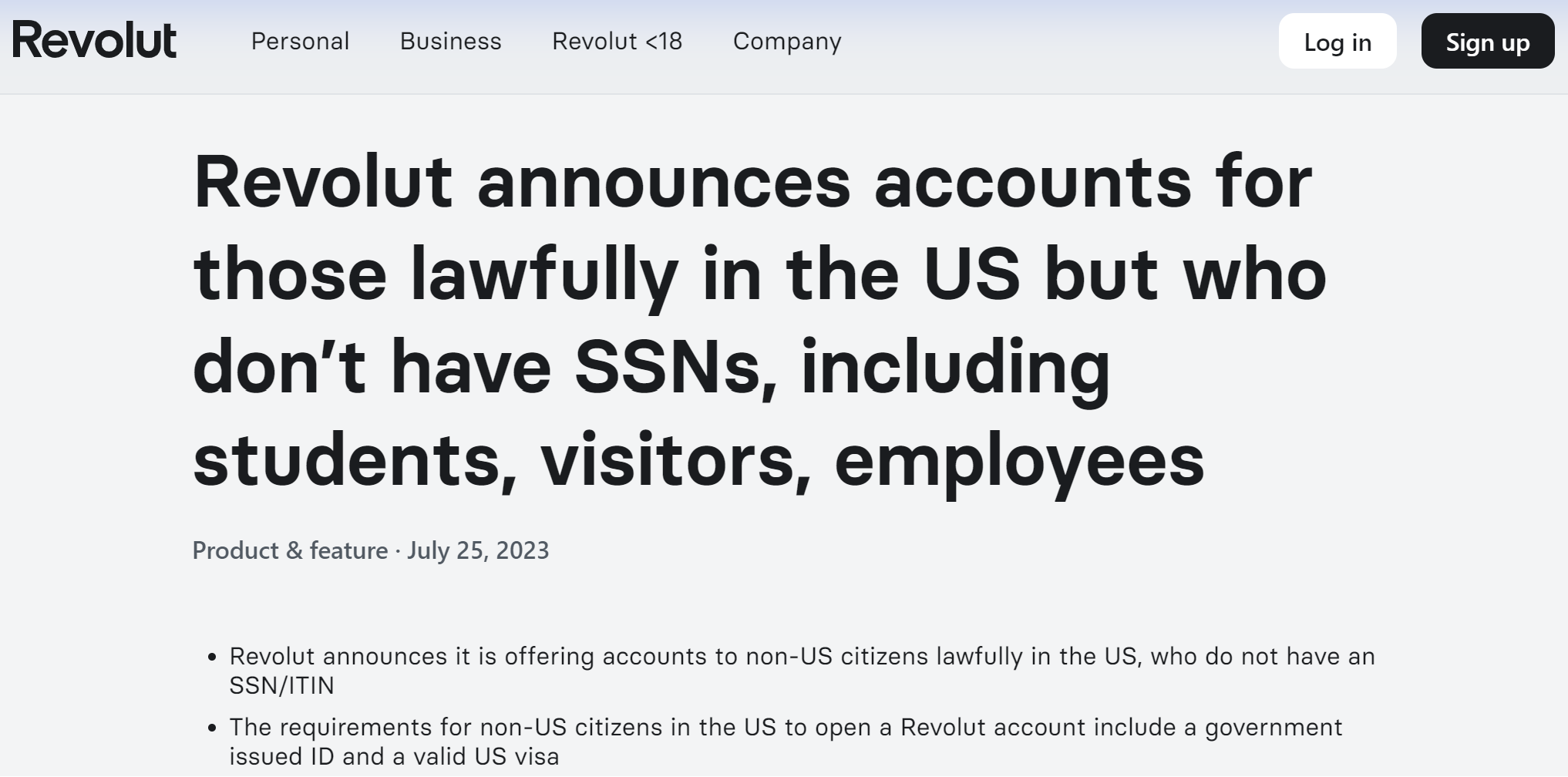
Crypto-based money transfer firms could theoretically help undocumented cash senders through anonymity, but that would be illegal. The legal fintech response was to accept alternative identity documents while retaining regulated KYC. Yet much of the 2023 cohort served an adjacent segment rather than the hardest case: Revolut’s no-SSN account remained limited to lawful visa holders, while Majority accepted foreign passports but still opened regulated U.S. accounts.
By 2026, the outcome was revealing. Alza shut down. Maza was acquired after expanding into solopreneur finance. The Majority app remained active, charging $6.99 a month for a bundle of banking, calling, top-ups, and transfers, while Revolut absorbed no-SSN users into its global multiproduct platform. The survivors found another way to monetize customers: remittances were an acquisition and engagement feature, not the business.
Fintech companies operating in the largest developing countries, such as China and India, have had an even greater impact on unbanked consumers. Startups like Alipay, WeChat Pay, and Paytm have successfully brought hundreds of millions of previously unbanked consumers into the digital financial ecosystem, enabling them to receive money and make digital payments.
Another significant driver of banking the unbanked is the implementation of real-time payment systems and payment accounts by the governments of developing countries for their citizens. Examples include India’s UPI and Brazil’s Pix, which have brought tens of millions of previously unbanked citizens into the financial fold in recent years.
Global account ownership rose from about 50% in 2011 to 79% in 2024, reducing the unbanked population from 2.5 billion to 1.3 billion despite continued population growth. This progress came through regulated bank and mobile-money accounts, supported by digital IDs, government payments and instant-payment systems such as UPI and Pix. Crypto did not have to solve the “unbanked” problem for the problem to shrink by almost half.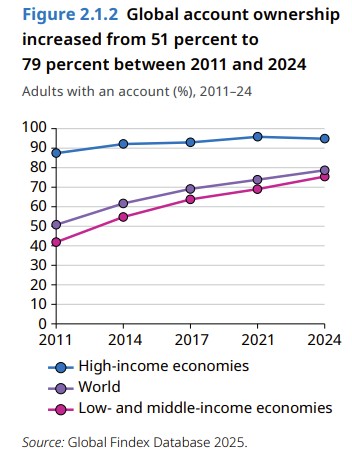
However, it does not pose a significant inconvenience or cost issue even for the remaining unbanked consumers on the receiving end of remittances. With approximately half a million Western Union agent locations, along with a similar count for Ria and MoneyGram, most unbanked recipients can easily collect money. Capacity is so high that around 30% of these locations see no remittance activity. While pockets of consumers will always live in highly remote areas, reaching them electronically in a cost-effective way would require expensive technologies like Starlink.
Unbanked consumers are not significantly disadvantaged by pricing, since the sender covers most of the fees. Moreover, receiving money digitally is only slightly less expensive, typically costing <1% of the transaction amount.
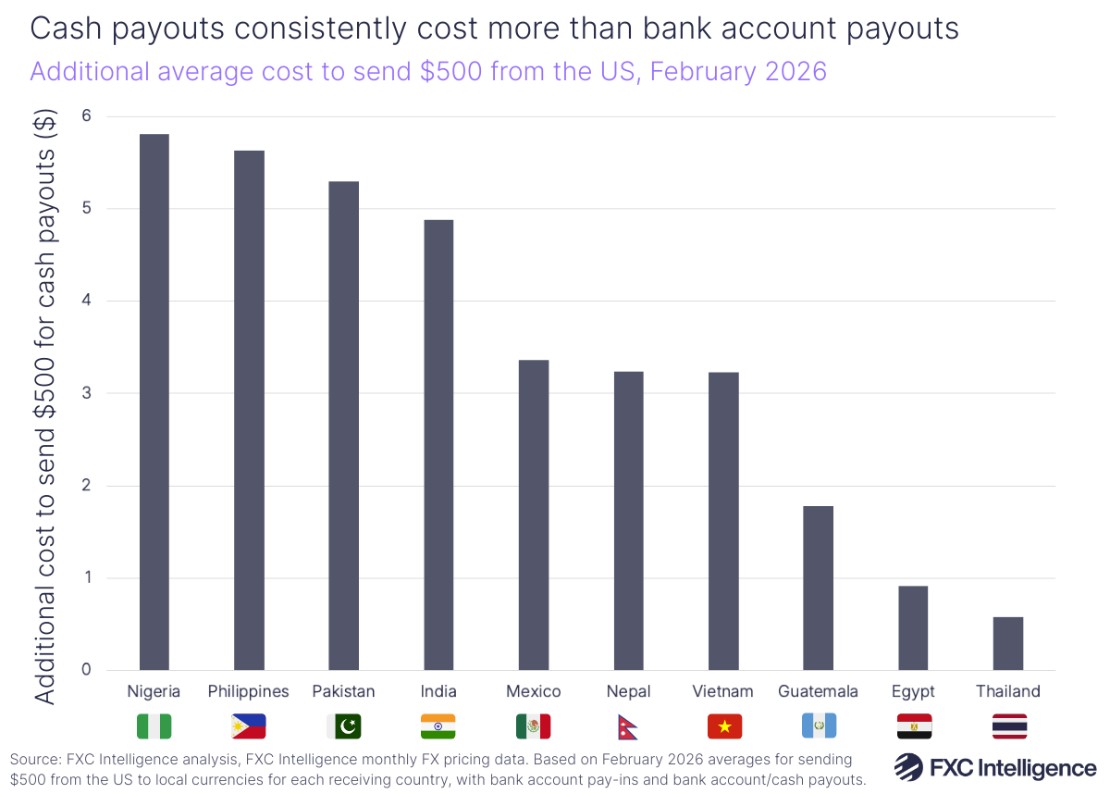
Unbanked consumers have been able to receive money instantly since the 1990s, albeit at a slightly higher cost to the sender. As developing countries have introduced real-time payment rails, money transfer incumbents and fintechs are quickly plugging their networks into those new rails, delivering money instantly across the globe.
Many early crypto remittance startups were established before 2015 by individuals without significant cross-border expertise who were unaware of these facts. They genuinely hoped to help the unbanked send remittances. In contrast, founders of blockchain-based startups that emerged after 2016 typically came from the industry and were well aware of this information. Nonetheless, they still repeat the same pitch of aiding the “2 billion unbanked” while targeting digitally savvy, more affluent consumers.
Not surprisingly, crypto usage for sending money has remained tiny. For example, in the US, the share of adults who use cryptocurrency to send money to friends or family has stalled at around 1%.
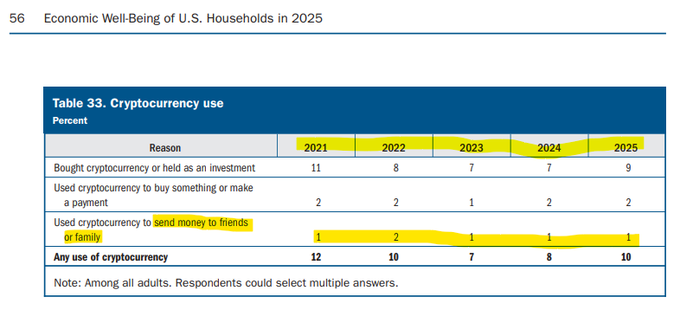
Source: Fed
There is good news for crypto enthusiasts who genuinely embraced this novel technology to alleviate the suffering of the poor, unbanked, women, and other marginalized groups. Don’t be disheartened by these individuals’ lack of crypto adoption. Even if the crypto ecosystem disappeared tomorrow, traditional technologies and methods have a proven track record of effectively addressing poverty and meeting the financial needs of these marginalized populations.
Bitcoin/Crypto/Blockchain money transfer is instant and, thus, doesn’t carry the FX volatility
The “nearly-instant-free” transfer via Bitcoin was valid to some extent until mid-2015, but the Bitcoin community couldn’t solve a technical problem that led to systematic transfer delays and higher fees (see details here). However, Blockchain proponents associated with the likes of Coinbase and Ripple often make misleading or ignorant statements about traditional fiat-based players, claiming they provide an inferior service. They often point to the enormous time lag for sending money using traditional methods. Here is an idiotic explanation from the interview with Ripple’s executive in October 2019:

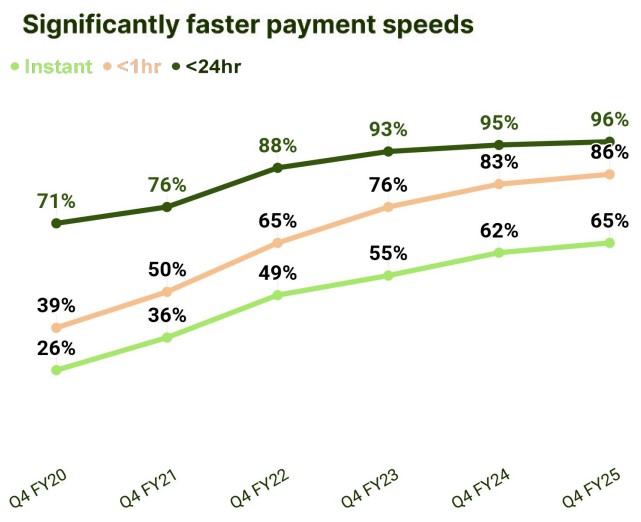
In reality, starting in the late 90s, all major money transfer providers offered transfers in minutes. Since the mid-2000s, Xoom has been offering the same transfer speed digitally. By 2025, Wise (a global digital leader in cross-border money transfers) had 96% of one-day transfers, and 65% of all transactions were instant (by 2026, the under-20-second share had risen to 77%).
By 2025, 75% of SWIFT payments reached the beneficiary bank within 10 minutes and more than 90% within an hour. Yet that international leg accounted for less than 20% of the total elapsed time; over 80% was spent after the payment left SWIFT and within the receiving country. Purpose-of-payment reporting, FX controls, non-24/7 infrastructure and manual processing caused most of the delay.
Stablecoins may accelerate settlement between institutions, but unless they bypass or automate that local beneficiary leg, they have only a marginal effect on end-to-end speed. Swift’s 2026 retail scheme makes the counterfactual even clearer. With common rules for fees, FX, full-value delivery and last-mile processing, Australia-to-Spain payments have reached beneficiary accounts in as little as 23 seconds, without blockchain.
In the world’s largest corridor, USA-to-Mexico, most of the providers already deliver funds in minutes. Non-crypto money transmitters can send money instantly because they have built strong risk management capabilities, local bank connectivity, and pre-funded daily needs. Plus, sending money via a debit card, while costing slightly more, is also instant, as providers see less risk in those transfers. Banks historically relied on outdated government networks, which could take a few days to confirm a transfer. However, since the mid-2000s, Australia, the UK, and other countries have implemented near-real-time payment capability. In some countries, like the U.S., two local instant rails exist: bank-owned and government-owned, RTP and FedNow, respectively. Similar implementations are underway in other countries, with most developed countries expected to launch near-real-time rails by 2030.
Modern money-transfer providers can already make funds available to recipients within seconds or minutes in many major corridors by using prefunding, risk models and local instant-payment rails. Stablecoins may still improve 24/7 institutional settlement or reduce some prefunding requirements, but that back-end advantage matters to customers only when it measurably improves price, availability, reliability, or coverage. Moreover, routes that insert a volatile cryptocurrency such as Bitcoin or XRP as a third asset can create an FX double whammy through two conversion legs. Dollar stablecoins do not have the same intra-transfer volatility problem, although their on- and off-ramps still create conversion and FX costs. Here is how MoneyGram depicted its use of Ripple/XRP rail during its partnership in 2019-2021:
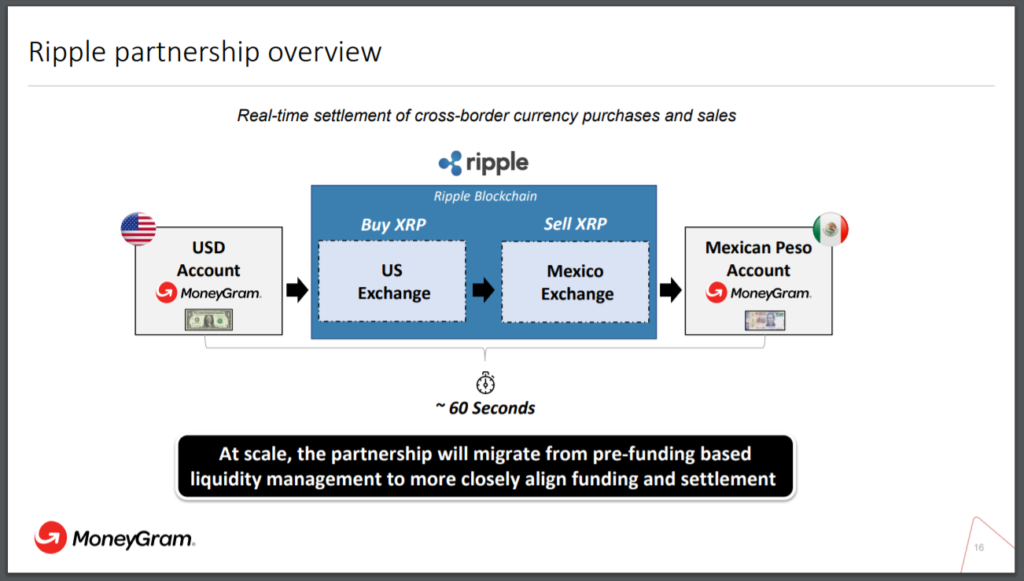
Instead of converting money directly between two widely traded currencies, dollars and pesos, MoneyGram bought and sold through obscure crypto. Because XRP’s trading volume is relatively small, its FX margins are naturally much higher than with fiat currencies, and, again, those margins have to be paid twice. The same disadvantage applies when other volatile cryptocurrencies are inserted as an additional FX leg:
Here is how HelloBit’s co-founder and CEO, Ali Goss, summarized this conundrum in Bitcoin Magazine in 2015:
“With bitcoin, you’re adding a third currency,” Goss said. “You go from U.S. dollar to bitcoin, and then from bitcoin to whatever the local currency is. You’re adding an extra FX move right there alone. That increases friction. On top of that, small startups don’t have a big FX department, and they don’t have the big abilities that come with such a department … they’re generating more costs for themselves, not less.”
The spreads are so high that even die-hard crypto cross-border players use non-blockchain rails to complete transfers for those destinations. Yes, you heard this right, EVERY so-called Bitcoin/blockchain money transfer startup pays banks to process a large portion, sometimes a majority, of its cross-border transfers. Here is ZipZap in this interview with CoinDesk:
“ZipZap uses a combination of traditional (Swift) bank payment rails and blockchain technologies to find the least expensive and most efficient transfer option…”
But why would MoneyGram absorb two additional XRP conversions? Ripple made the economics attractive. It invested $50 million in MoneyGram, acquiring approximately 9.95% of its shares, and separately paid MoneyGram in XRP to develop liquidity and maintain foreign-exchange trading activity on Ripple’s platform. MoneyGram recognized $11.3 million of these market-development fees in 2019 and $50.2 million in 2020. Here is how MoneyGram described the partnership to investors:

Ripple did more than offer MoneyGram a new rail: it invested in the incumbent and paid it $61.5 million over two years to create the liquidity and trading activity supporting XRP’s remittance story. MoneyGram received a substantial financial benefit; Ripple gained visible XRP volume, a marquee partnership and promotional evidence of real-world utility. The arrangement helped market XRP, but produced no evidence that XRP lowered MoneyGram’s underlying transfer costs or customer prices.
Now you can also appreciate why, during those years, Facebook leadership and their Silicon Valley friends looked at the Ripple scheme and wanted to join in by launching Libra/Diem.
In 2023, Coinbase still promoted its cross-border money transfers as having no fees to send/receive and instant availability:
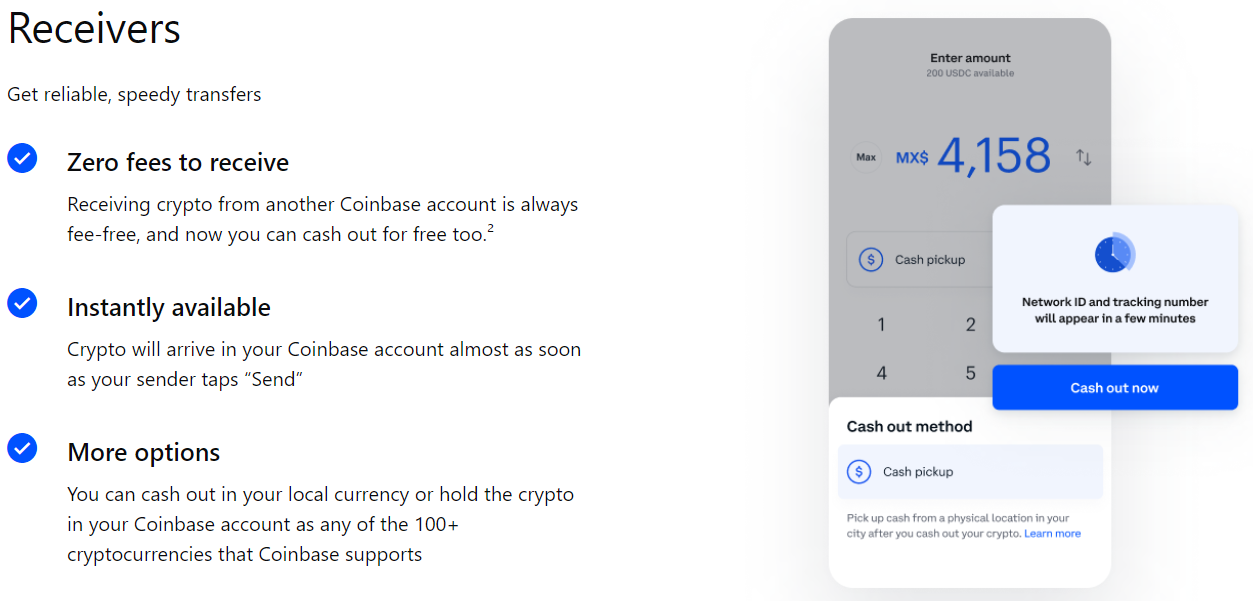
Most remittance senders do not initially hold crypto, and 70% of Coinbase recipients in Mexico immediately converted it to pesos. Coinbase therefore relied on Remitly and its licensed cash-pickup network for the customer-facing payout. In September 2022, Coinbase’s record month, customers in Mexico received only “hundreds of thousands of dollars,” compared with roughly $5 billion of remittances received by Mexico that month. Even at the highest amount consistent with that description, Coinbase handled less than 0.02% of the market. It had demonstrated repeated use among a small cohort while outsourcing the essential fiat payout to a traditional remittance provider. Here is how Remitly’s CEO characterized the arrangement in 2022:

Bitcoin/crypto/blockchain can dramatically reduce remittance prices
Most of the potential savings for international money transfers could be realized today, immediately, if senders stopped going to cash agents and spent 3 minutes linking their bank accounts on their smartphones using their existing providers like Western Union or Ria Money Transfer. Not understanding why so many senders continue to spend more while having a bank account and a smartphone will likely lead to many disappointments for the next generations of Bitcoin-, crypto-, and blockchain-based money transfer startups.
Examples of past disappointments are common- see the “Graveyard” section toward the end of this article, or read these insights from Bitcoin entrepreneurs. But still, too many Bitcoin remittance stakeholders kept repeating an outdated adage about a high markup charged by “traditional” providers and that a Bitcoin solution is 250x cheaper:
Here is another typical comparison from March 2019, highlighting the advantages of free, immediate remittances offered by blockchain startups compared with the slower, costlier services of traditional fiat-based firms. However, these articles consistently fail to explain why, despite having such advantages and significant marketing capital, as well as numerous pilot projects with established companies, none of these crypto remittance players have been able to demonstrate impressive transaction volumes, except in cases of partnerships involving paid transactions, such as Ripple with MoneyGram.

The short-lived Facebook venture Libra/Diem made similar claims. After facing challenges scaling Facebook’s P2P payments business through traditional means, David Marcus, the head of payments, established a blockchain-based company. Recognizing how difficult it is to get government permission to issue currency, Libra/Diem sought political cover by claiming its primary goal was to help billions of unbanked individuals with their remittance needs. However, it remains unclear how well they understood remittances at that stage. Here is what David Marcus said in late 2019:

You judge whether that ignorance was unintentional or whether Facebook was shamelessly using the world’s poorest to make a quick buck. A similar lack of understanding has been prevalent among Fintech experts. Here was Chris Skinner on a Breaking Banks podcast in 2017 (starts at 32:45):
“Now using companies like Abra a US citizen could send someone in Philippines a hundred dollars with hardly any commission taken off, compared to 25% or more being taken by traditional players.”
How much did that transfer cost at the time? 2-4%:

By checking price comparison sites for major remittance corridors, one can quickly discover that the weighted-average global margins of top incumbents have been falling toward 3% among traditional players and even lower for some fintechs.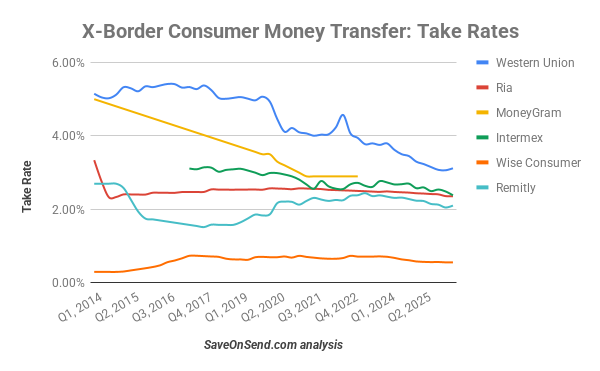
The World Bank’s headline average still overstates the price relevant to most competitive remittance flows. In Q3 2025, the simple global average for sending $200 was 6.36%, but the corridor-volume-weighted average was 5.04%. Digital-only MTOs averaged 3.54%, while the SmaRT benchmark, based on the three cheapest qualifying services in each corridor, was 3.29%. High remittance prices increasingly reflect expensive channels and poorly served corridors rather than the absence of low-cost alternatives.
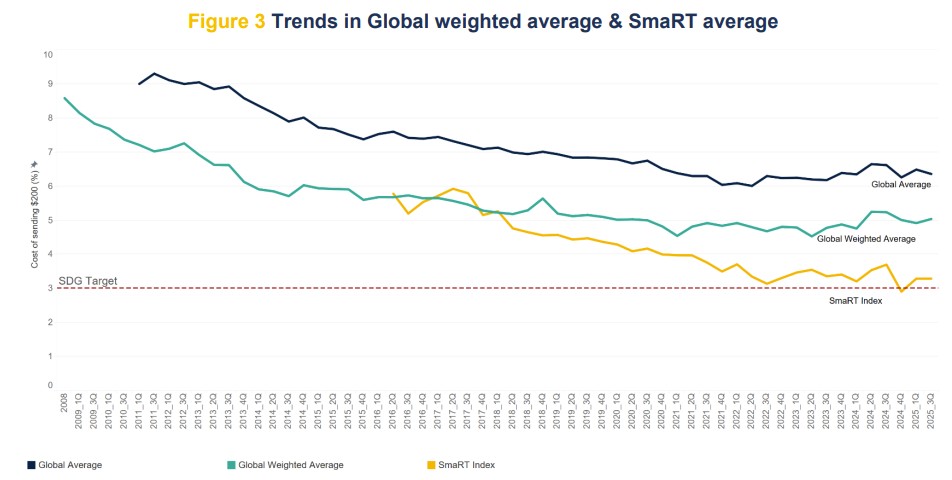
Source: World Bank
Average prices across the world’s largest remittance corridors are generally similar, except in South Africa.
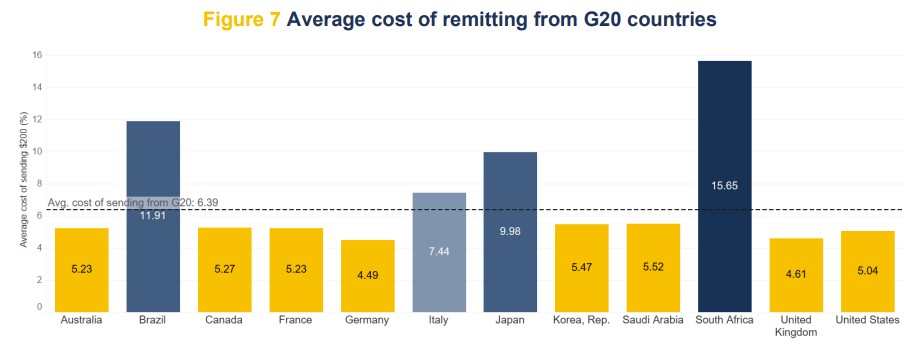
Source: World Bank
South Africa saw episodic improvement rather than convergence. The average cost of sending $200 fell from about 16% in 2015 to 11% by late 2024, then returned to 16% in 2025. It remained the costliest G20 sending market, versus a 6% G20 average. The 2025 rebound was amplified by extreme FX-margin readings in the Malawi corridor, but even the lower 2023–24 results remained far above peer markets. Distribution, regulation, and customer behavior remain the binding constraints.
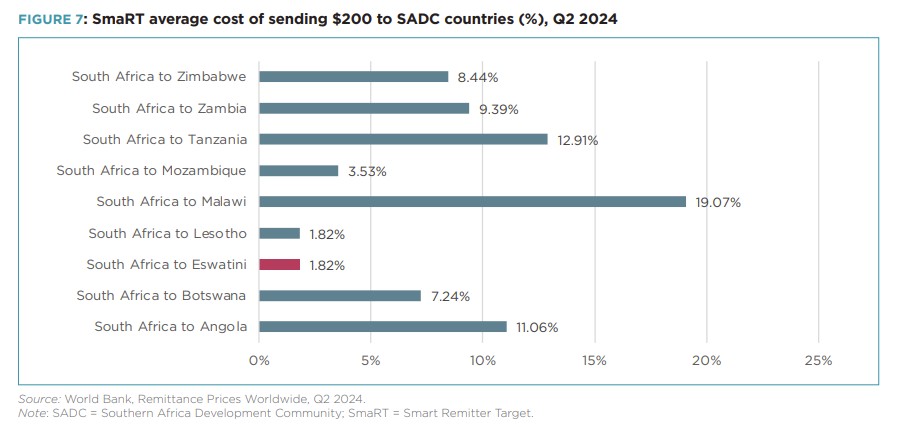
Such data is hard to gather and maintain, so the actual prices might be even lower, as was discovered in 2016:
What is causing South Africa’s outbound remittance prices to be many times more expensive than those from a country like Russia? Most experts would claim that it is due to two issues: de-risking by banks and exclusive partnerships with retailers by Western Union and MoneyGram.
“A major barrier to reducing remittance costs is de-risking by international banks, when they close the bank accounts of money transfer operators, in order to cope with the high regulatory burden aimed at reducing money laundering and financial crime. This has posed a major challenge to the provision and cost of remittance services to certain regions.”
“… the core issue with WU is their exclusivity clauses that have been used for decades to successfully lock markets to one provider, who can then increase their mark-up fees as there is no alternative.”
Neither of these reasons applies. It is easy to blame ‘banks’ or ‘Western Union,’ but the actual root causes are 1) opaque and corrupt governments with regulations that favor banks over Money Transfer Operators (MTOs), 2) consumers who don’t care to shop around, and 3) incumbents who are content with maintaining their market share status quo.
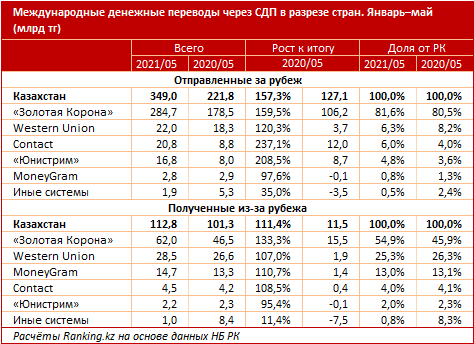
In the former Soviet Union region, these constraints don’t apply to remittances, resulting in lower margins, with Golden Crown becoming the market leader across many countries before the war between Russia and Ukraine. For example, see the table below for Kazakhstan for 2020-2021 – some company names are in Cyrillic, but you can probably guess their English names, too.
For Bitcoin/crypto/blockchain-based remittance providers, whose customers tend to be tech-savvy early adopters, online remittance margins in top corridors are in the 1-3% range. For example, in the world’s most advanced corridor, USA-to-India, many providers don’t charge any fees for digital transfers, and their FX markups are typically around 0.5-1%:
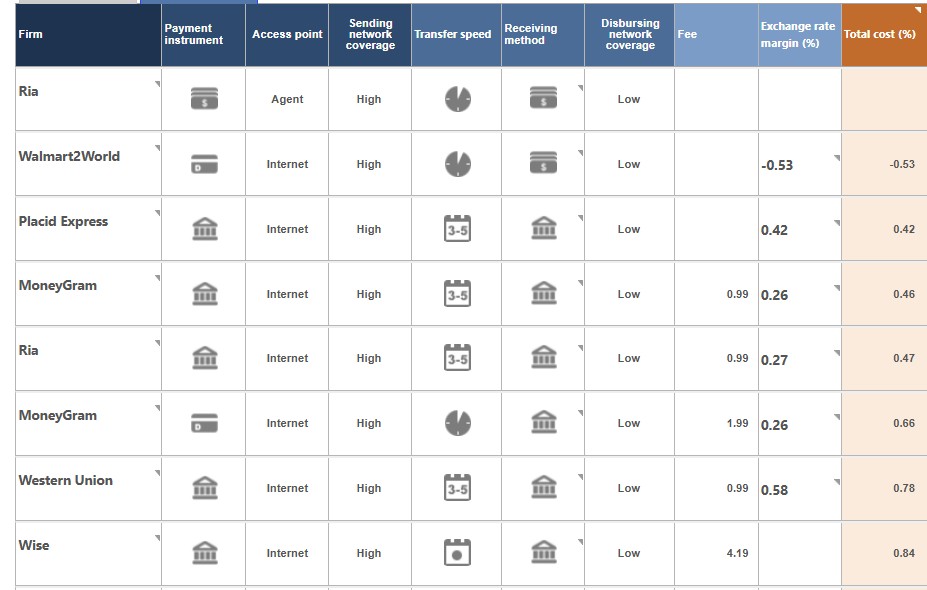
All-in cost of sending $200 from the United States to India, including the transfer fee and exchange-rate margin. Data collected August 4–28, 2025. Source: World Bank Remittance Prices Worldwide.
The same competitive ceiling remains evident in the U.S.–China corridor. In Q3 2025, the World Bank recorded all-in prices of approximately 1.9% for Western Union, 2.0% for Remitly, and 2.5% for Wise on $200 online transfers, including both fees and FX margins.
Early Bitcoin remittance comparisons often excluded part of the end-to-end cost. Zebpay’s 2016 exhibit compared a conventional fiat-funded remittance with a transfer in which the sender already held Bitcoin. The small print therefore omitted the sender’s cost and spread for acquiring Bitcoin, preventing an apples-to-apples comparison of the amount ultimately received in fiat.
But behind the small font was a misleading comparison between sending money with a popular, easily verifiable fiat-to-fiat method and a transaction originating in Bitcoin, without mentioning a Bitcoin-to-fiat spread. On top of that spread, Bitcoin providers were charging increasingly higher fees (source here):
The fee volatility became so severe that in October 2017, Bitspark, one of the more prominent B2B providers of Bitcoin money transfers, switched to another blockchain.
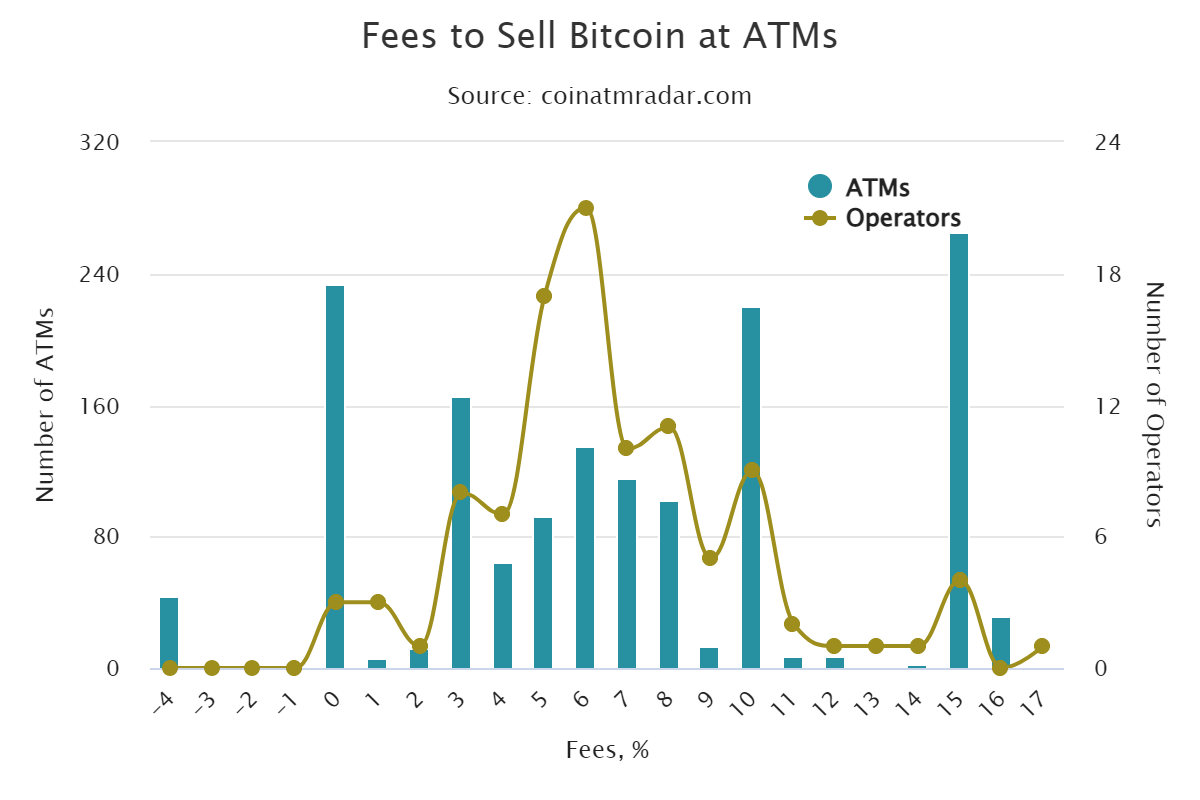
Cash payout remains important in several major remittance markets, but crypto ATMs do not offer a competitive alternative to established agent networks. Their fees, exchange-rate spreads, limited coverage, cash availability and compliance requirements usually make the complete crypto-to-cash transaction more expensive and less convenient.
As mentioned, some of the world’s largest remittance corridors allow currency transfers, such as USD-to-USD transfers from the US to the Philippines or China. This naturally eliminates the need for a provider to manage FX volatility and leads to very attractive pricing for consumers:
The smaller the corridor, the weaker the return on local licensing and integration. By April 2026, Wise had 80+ regulatory licenses, supported 40+ currencies across 160 countries, and still launched outbound service market by market—Mexico in January 2025 and Chile in July 2026. Western Union’s 2026 service reached 185+ countries and territories. Global scale expands coverage; it does not eliminate the cost of building each sending market.
Crypto startups claimed that blockchain would serve consumers overlooked by profit-maximizing incumbents. American Banker repeated that argument for Bridge21, invoking desperate remitters and Sub-Saharan African fees approaching 10%:
Bridge21 did the opposite. It launched a bank-to-bank U.S.–Mexico service, using differences in Bitcoin prices between the two countries to price transfers. It chose the world’s largest and one of its most competitive remittance corridors, where incumbent FX margins were already 1–3%:
The same benchmarking error resurfaced in 2023. Bridge co-founder Zach Abrams blamed fiat rails for a 4% average U.S.–Mexico remittance cost:
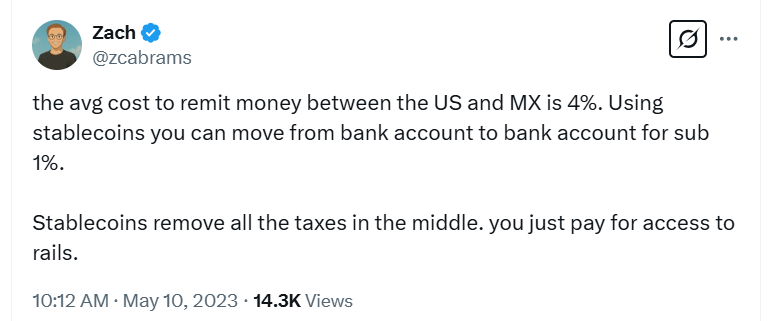
Bridge’s 4% benchmark overstated what digitally engaged customers paid in the U.S.–Mexico region, where leading fintechs charged about 1–2%. Stripe’s $1.1 billion acquisition validated the enterprise value of stablecoin infrastructure, not a breakthrough in consumer remittance pricing.
In July 2026, Banca d’Italia published the first central-bank mystery-shopping test of stablecoin remittances, actually sending $200 in USDC across multiple corridors. The results confirmed that cheap blockchain settlement does not mean cheap money transfer. The on-chain leg averaged only 0.4% of the transfer amount, while total end-to-end costs ranged from 0.3% to almost 9%. Funding, crypto purchases and sales, FX, and withdrawals accounted for most of the costs. Stablecoins showed no systematic cost advantage over traditional remittance channels. Where domestic instant-payment rails worked well, the complete stablecoin transfer took less than 20 minutes; where ordinary bank transfers were required, it still took one to two business days. In other words, the blockchain was rarely the bottleneck.

That does not make stablecoins useless as a back-end rail. Remitly and Coins.ph provide a useful example of the narrower role they can play inside an otherwise conventional remittance. The sender pays Remitly in fiat, stablecoins can be used in the middle, and Coins.ph converts the funds into pesos for payout through local financial channels. While direct crypto-native products account for roughly 1% of formal Philippine remittances, B2B2C stablecoin activity may already be closer to 3%.
PayPal’s own remittance subsidiary provides another useful test. Xoom has always charged a $0 transaction fee when a transfer is funded with PYUSD. Until February 2026, bank-funded Mexico transfers were also free; PayPal then introduced bank-funding fees while leaving PYUSD at zero. But Xoom still does not send PYUSD to the recipient. It sells the PYUSD into dollars and completes the ordinary fiat Xoom transfer. In an August 2026 $1,000 Mexico quote, a bank deposit cost $0 from PYUSD, $0 from an ordinary PayPal balance, and $6.09 from a bank account; cash pickup cost $0 from PYUSD, $13.89 from a PayPal balance, and $15.59 from a bank account. The stablecoin now has a clear pricing advantage, but PayPal created it by pricing funding methods differently, not by demonstrating that blockchain reduced Xoom’s underlying FX or payout cost.
The economic purpose of stablecoin flows is almost impossible to verify. By 2025, stablecoins could have been behind 10% of remittances into Nigeria, but nobody knows. Regulators also face an ugly trade-off: tighter oversight can push activity toward offshore exchanges, self-custody, WhatsApp/Telegram P2P, cash brokers, and informal FX dealers.
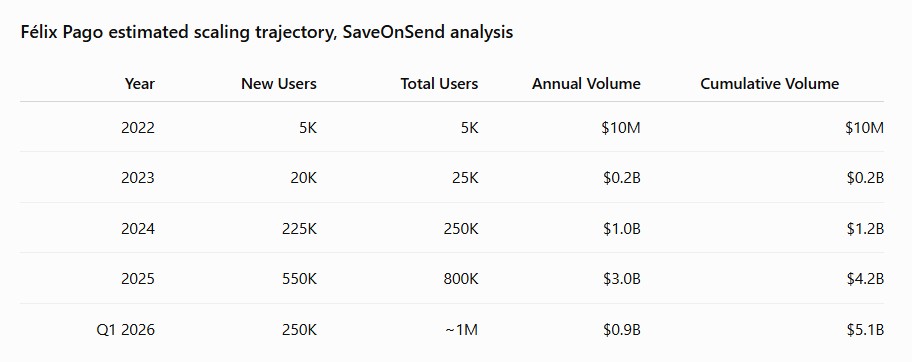
Félix and Aspora provide the strongest current test, but they are very different stablecoin cases. Félix had surpassed $6 billion of cumulative remittances and 1 million users by May 2026. Stablecoins are genuinely part of its backend: its U.S.-Mexico flow has been documented as USD → USDC → Bitso → MXN → domestic payout, and Félix is now building multi-issuer settlement optionality. But it has never disclosed what share of its transfers actually uses stablecoins, while conventional processors, MTOs, treasury, FX liquidity, and local payout networks remain essential.
Quick aside: Mobile Money
Separate from crypto, “mobile money” is a narrow category that typically refers to payments made from a customer’s account with their telecom provider. Although Western Union piloted it in 2007, this narrow model remains a small part of global remittances. Even GSMA’s broader “mobile money-enabled” category, which also counts transfers completed through intermediaries such as Western Union, accounted for only 4% of global international remittances and remains concentrated in Sub-Saharan Africa.
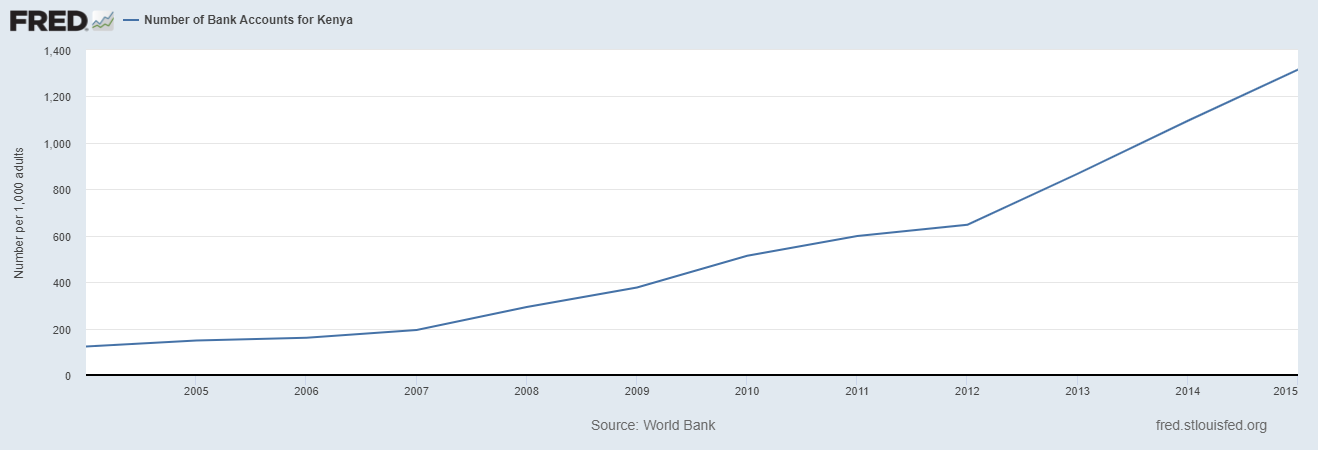
It took off in those countries because payment card infrastructure was inadequate at the time. The most famous example is M-Pesa, launched by Vodafone in 2007. M-Pesa is often credited with creating Kenya’s financial-inclusion boom. In reality, Kenya’s banking industry was already expanding rapidly, and well-off consumers had another convenient option for sending money.
Remittance volumes within African countries tend to be relatively small and are thus outside the focus of digital expansion by incumbents or Fintech startups. As a result, a mobile money method could be the most cost-effective option for these corridors when compared to cash-to-cash sending:
… Back to Bitcoin/Crypto/Blockchain
Another argument favoring Bitcoin/crypto/blockchain’s ability to reduce remittance costs is that it applies to small transfer amounts. The underlying assumption is that such transfers would then dramatically increase in quantity, i.e., if it costs little to send $10 to a homeland, lots of migrants will begin initiating lots of small transfers. While some increase in smaller-amount transfers has been expected (see this interview with Western Union’s executive), there is no evidence of a significant trend.
Even for tiny transfers, conventional providers leave little room for a cheaper rail to matter. Sending $20 from the U.S. to Mexico costs around a buck from large banks and leading fintechs alike.
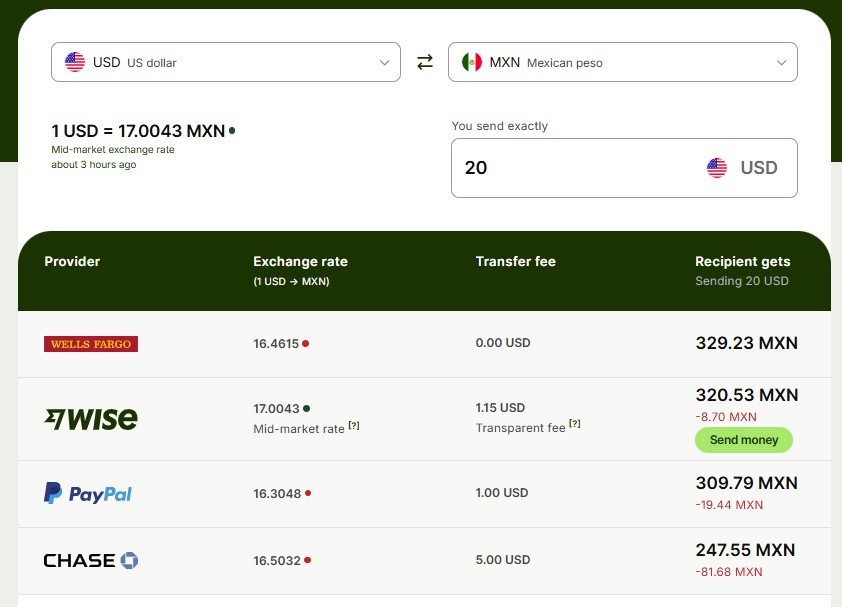
Comparison of providers: U.S. to Mexico, $20, August 2026. Source: Wise comparison tool.
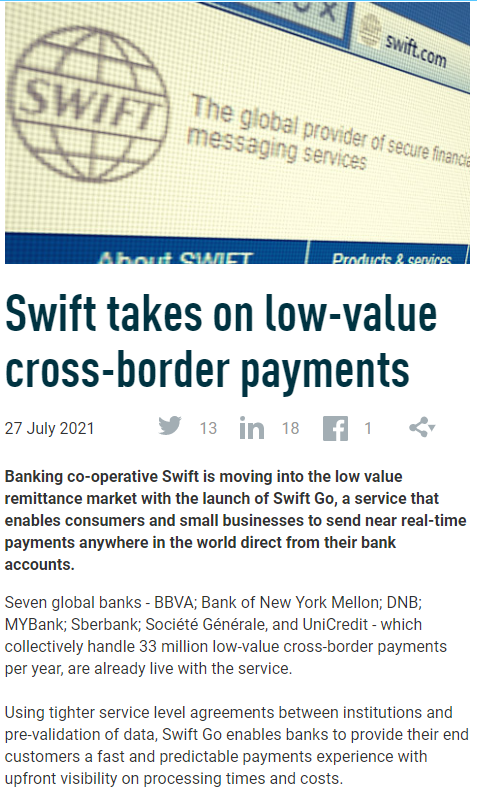
The last hope for Bitcoin’s differentiation in small-transfer use cases ended in 2021, when SWIFT launched a dedicated product for that use case.
Can crypto dramatically reduce the cost of consumer remittances through a cheaper back-end rail?
If crypto cannot win consumers directly, it could still improve remittances by lowering existing providers’ costs. But for that to matter, two conditions must hold: the back-end rail must represent a meaningful share of the provider’s total cost, and crypto must materially reduce that cost after accounting for liquidity, FX, and compliance.

Source: Western Union 10K 2025
Let’s review the financial statements of publicly traded consumer remittance companies.It becomes apparent that most of their costs are related to payments for receiving and discharging funds to and from customers, customer acquisition, channel infrastructure, customer service, and risk-management compliance, not to recording transactions or moving money internationally (read this SaveOnSend article for more details). Hence, providers are eagerly looking for more cost-effective ways to collect and distribute funds vis-a-vis customers, acquire customers, deploy offline and online channels, service customers, and manage risks of releasing funds before getting paid, not functions where Bitcoin offers a distinctive cost advantage. For example, Western Union spent 49% of all expenses in 2014 on “agent commissions,” and by 2025 that portion declined to 45-46% – whether the underlying currency is fiat or Bitcoin wouldn’t make any difference.
Or, let’s consider fraud-related expenses – the central issue in the remittance industry, like the case of “employee impersonation” at Xoom, or when people lie about 1) having sufficient funds in their bank account, or 2) not sending money, or when hackers take over online accounts. Again, it is not clear why a Bitcoin-based provider would be much better at preventing such “front-end” fraud unless it is a so-called “full Bitcoin” transfer (no on- and off-ramp conversion with fiat). This could be a safer infrastructure, but it has a very slim chance of mass adoption unless we start seeing billions of dollars spent on PR & Marketing globally.
What do remittance providers actually spend on banks? Intermex offers unusually detailed disclosure. In 2025, it moved $23.8 billion across 53.9 million remittances and paid $26.6 million in bank charges: about 49 cents per transfer, or 0.11% of principal. Even that includes more than correspondent settlement, so replacing SWIFT could save only a portion of it. By comparison, Intermex paid $352 million to sending and paying agents, more than 13 times as much. Even if blockchain somehow eliminated all bank charges, the maximum customer savings would be about 50 cents per transfer.
Stablecoins can potentially attack one meaningful back-end cost that bank charges miss: prefunding. Western Union estimates that working capital parked across destination markets can cost 6–8% annually; moving that liquidity into USDPT could turn roughly a 6% capital cost into Treasury yield. But its own digital-assets head identifies the remaining constraint: agents still need local currency, and if stablecoin off-ramp FX is worse than the existing fiat arrangement, “you fail at last mile.”
Nevertheless, by 2017, most large financial institutions and government financial entities were experimenting with distributed ledger technologies, either on the Blockchain or via more private variants. Such a test-first-think-later approach yielded no positive surprises (see examples here and here). Insufficient processing speed, low grade of security, and malfunctioning technology were normal for early tests of any new network:
“One of the main lessons from this experiment is that the versions of distributed ledger currently available may not provide an overall net benefit when compared with existing centralized systems for interbank payments. Core wholesale payment systems function quite efficiently…”
A seminal moment in the Blockchain-for-back-end debate came in March 2018 when a famed economist, Nouriel Roubini, published “The Blockchain Pipe Dream,” which included the following paragraph:
“Bitcoin is a slow, energy-inefficient dinosaur that will never be able to process transactions as quickly or inexpensively as an Excel spreadsheet. Ethereum’s plans for an insecure proof-of-stake authentication system will render it vulnerable to manipulation by influential insiders. And Ripple’s technology for cross-border interbank financial transfers will soon be left in the dust by SWIFT, a non-blockchain consortium that all of the world’s major financial institutions already use. Similarly, centralized e-payment systems with almost no transaction costs – Faster Payments, AliPay, WeChat Pay, Venmo, Paypal, Square – are already being used by billions of people around the world.”
By the second half of 2018, some incumbents began canceling their blockchain pilots. Here is the reasoning from Citi’s Head of Innovation Lab (source here):
“If we are talking about cross-border payments, how many banks do we have across the world – and how many of them are already on-boarded on SWIFT? And how long has it taken SWIFT to onboard all those banks?”
The disappointing announcements continued in 2019. Here is a typical conclusion from the experiment launched by the Bundesbank together with Deutsche Börse in 2016 and terminated in late 2018 (source here):
“The blockchain solutions did not fare better in every way: the process took a bit longer and resulted in relatively high computational costs,” Weidmann said in Frankfurt on Wednesday. “Similar experiences have been made elsewhere in the financial sector. Despite numerous tests of blockchain-based prototypes, a real breakthrough in application is missing so far.”
Bitcoin/Blockchain money transfer will destroy Western Union
Obsession with crushing Western Union has been a massive distraction. Even in the Philippines, one of crypto’s strongest remittance markets, direct crypto remittances still account for only about 1% of consumer transfers after more than a decade. To put things into perspective, among fiat-based fintechs, only Wise has surpassed Western Union’s transfer volume after more than a decade: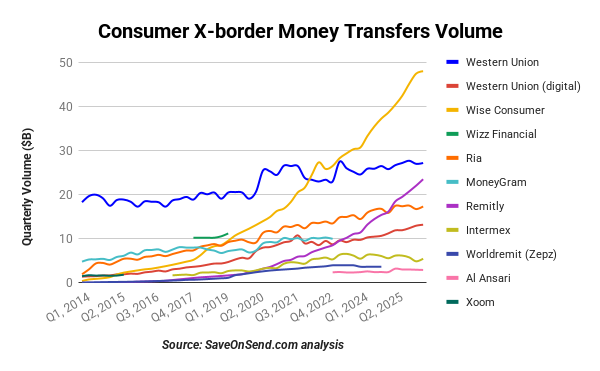
In 2016, Rebit and Bloom claimed that Bitcoin providers handled 20% of the Korea-to-Philippines corridor, implying $1–2 million per month in volume through Sentbe and Payphil. That would have been material for crypto, although the entire Korea corridor was only $0.2–0.3 billion annually and remained tiny beside the Philippines’ largest remittance sources:
The claim also nearly matched the Philippine central bank’s estimate of about $2 million per month for remittances across all inbound corridors and virtual currencies. Yet the 20% figure circulated without transaction evidence, and the providers did not substantiate it when SaveOnSend asked:

Eventually, the Philippines Central Bank began estimating crypto volumes for inbound remittances. By 2018, it was $8.77 million (or 0.03%), while Payphil was no longer in business.
For a while, it was common to misinform the general public about Western Union, suggesting they charged 10% for limited transfer amounts and only in the US:
Meanwhile, Western Union has proven quite agile in its digital evolution. It was the first to provide an online channel in 2001, the first to experiment with mobile money in 2007, and the first among well-known remittance providers to invest in blockchain startups and experiment with blockchain:
The current U.S.–India comparison above shows that Western Union can still match or beat some digital challengers on total customer price. Crypto startups therefore compete with an incumbent that can price aggressively in the largest corridors.
And that may be the biggest “blind spot” of Blockchain-based startups. They have an image, wishful thinking, of Western Union as a cash-only business that missed telephony and kept hanging onto the telegraph. The reality is quite different. Western Union would exploit Bitcoin-blockchain rails as soon as they become a viable alternative. Remember, profits and costs are in the first and last mile, not the rails (read this SaveOnSend article for more details). Finally, while Western Union’s market share and stock price have been slowly declining, there are no signs of imminent demise: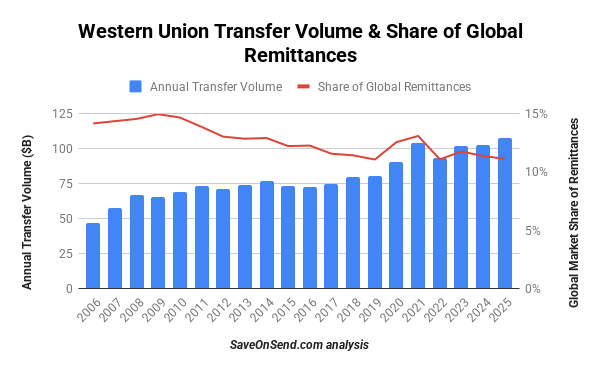
The only reason preventing mass Blockchain/Crypto money transfer adoption is [enter your favorite]
For over a decade, true believers have used the phrase “gradually, then all at once” to explain the imminence of Blockchain/Crypto adoption for money transfers. It highlights one piece of news and predicts that it foreshadows a trend. The irony is that this phrasing originates from Ernest Hemingway’s The Sun Also Rises: “How did you go bankrupt?” – “Two ways. Gradually, then suddenly.”
Rather than learning and embracing the challenging reality of consumer remittances today, these experts believe Blockchain is a “game-changer” for remittances. They are betting on a miracle of new technology taking off once enough remittance consumers hear about its features.
What would drive such mass awareness has, over the years, been some “game-changing” event; pick your favorite:
- Donald Trump becomes president and halts all remittances for undocumented migrants from Mexico.
- An economic crisis in a large country can cripple banks, impose capital controls, or trigger hyperinflation (e.g., Greece, Venezuela).
- A large retailer agrees to accept Bitcoin for money transfers.
- Bitcoin remittance startup cuts its fees and conversion rates to zero.
- Low-income consumers learn to use advanced smartphones.
- The government supports Bitcoin adoption (El Salvador).
- Stablecoins are regulated in the US.
Rather than asking why crypto still struggles to reach even 1% of legal consumer remittances in one of its strongest markets, the payment industry pundits prefer to wonder about poor people in mysterious Africa (read more here):
“Potentially, Africa’s huge unbanked population combined with the burdensome process of opening and operating a bank account should make Bitcoin an instant hit. However, its adoption has been irritatingly slow even though the basic infrastructure is not missing. It is estimated that by the end of this decade that 80 percent of the continent’s more than 1.2 bln population would be using Smartphones. Then what hinders Bitcoin penetration in Africa?…”
Take any claim of crypto adoption for remittances with a grain of salt. One of the most prominent examples of supposed success is Bitso. This Mexico-based crypto exchange claims billions in remittance transfers, mainly from the US to Mexico. However, government agencies license and heavily scrutinize international money transfers. If millions of consumers send monthly remittances in crypto, why is no licensed operator (MTO) taking credit for adopting such groundbreaking innovation?
In early 2024, Bitso published a report stating that Ripple was a major contributor to that remittance volume. Given Ripple’s documented payments to MoneyGram to create XRP liquidity, Bitso’s disclosure raises the same diligence question: how much of this XRP-linked volume reflected organic remittance demand, and how much was generated through commercially incentivized routing?
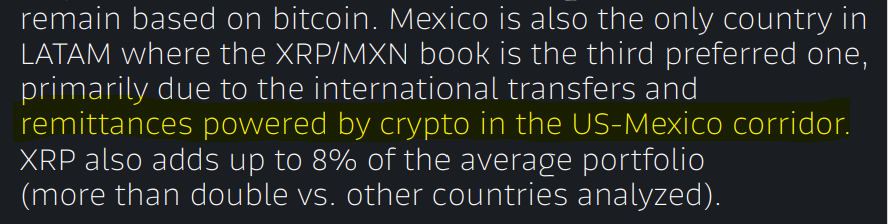
Bitso later claimed it processed more than $6.5 billion in U.S.–Mexico remittance volume in 2024, accounting for over 10% of the corridor. Requests for the originating MTOs, transaction count, active senders, asset mix, customer pricing, and independent verification remained unanswered.
El Salvador’s failure with Bitcoin for remittances
So the biggest barrier to mass adoption might be that the crypto community still lacks skeptical practitioners who would treat a new payment rail and cryptocurrency as just another novelty and know how to navigate the headwinds. But time and time again, the execution is lacking. When El Salvador embraced Bitcoin as legal tender and encouraged remittance users to switch from their existing providers in 2021, here was the quality of the official Bitcoin wallet:
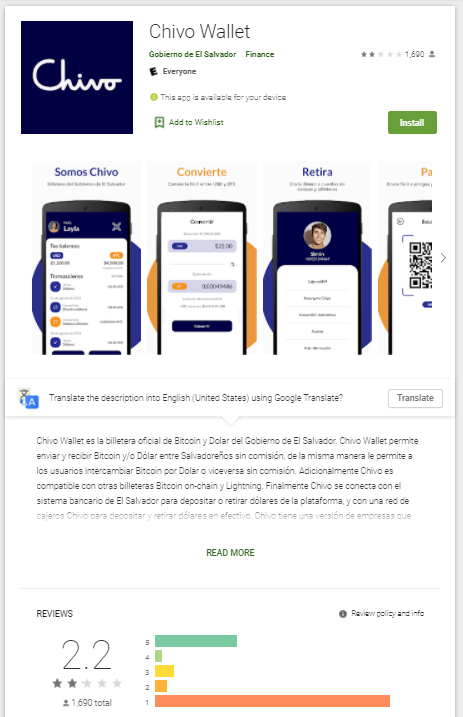
Even more shocking was the reaction from crypto heavyweights. For a decade, they have been dreaming of governments that do not impede the adoption of Bitcoin and other cryptocurrencies. El Salvador moved beyond anyone’s wildest dreams by paying citizens to download a Bitcoin wallet and pressuring merchants to accept it. Has any major player opened an office in El Salvador, moved there, pitched in with marketing to persuade Salvadorans in the US to send remittances via this new rail, or assigned their best developers to improve the Chivo wallet? Nope.
The results were predictably disappointing, with Bitcoin remittances in decline since their launch in 2021, falling to around 1% of monthly volume by 2023:
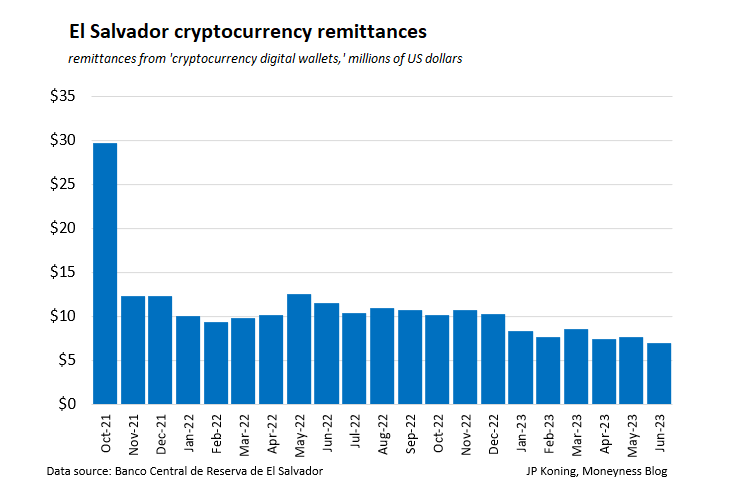
By 2026, crypto-wallet remittances had fallen further to just 0.7% of total remittances, confirming that even legal-tender status, government subsidies, and mandatory merchant acceptance failed to produce material adoption. El Salvador then effectively retreated from the experiment: Bitcoin acceptance became voluntary, taxes reverted to being paid exclusively in dollars, and the government began unwinding its role in Chivo. Its next experiment, Sivar, reverses the original model: consumers send and receive dollars while stablecoin settlement on Base is hidden in the back end, with a private operator running the platform and government identity and civic infrastructure supporting distribution. This is a much better architecture, but it also implicitly concedes that consumers did not need or want crypto as the payment product.
Specific examples of Bitcoin money transfer providers
Graveyard – closed or pivoted away from cross-border consumer money transfers:
- October 2020: Rebit.ph shuts down after raising $100K in 2015. It generated around 100 daily transactions, profiting from the FX-Bitcoin spread. Read this article from its former insider.
- October 2017: Bitspark pivots to B2B (investors: RGAx), shuts down completely in March 2020
- July 2016: Freemit shuts down (investors: Alchemist Accelerator)
- January 2016: Romit shuts down (investors: 500 Startups, AltaIR Capital)
- November 2015: BitPesa pivots to B2B (investors before pivot: DCG, Pantera).
- Launched in 2013, BitPesa initially was the best-known “use case” for Bitcoin consumer remittances to a few countries in the middle of Africa. However, as BitPesa struggled to gain traction among consumer remittance users, it discovered that its typical early adopter was a small business owner who occasionally sent money.
- Facing this reality and struggling in its initial outbound market, the UK, BitPesa expanded its marketing to potential senders in other countries like Canada and the USA and began targeting B2B cross-border payments (see an informative presentation by BitPesa’s CEO).
- BitPesa raised close to $2M initially, and its transfer volume grew at 30%/month from $50K in January 2015 to $400K by July. As of November 2015, nearly all its customers used BitPesa for business needs.
- October 2015: Bitstake->NairaEx
- August 2015: Beam shuts down (investors: MTT Group)
- July 2015: Cryptosigma->Toast (investors before pivot: Startupbootcamp)
- June 2015: 37Coins shuts down (investors: 500 Startups)
- April 2015: Buttercoin shuts down (investors: Google Ventures, Y Combinator)
- 2015: HelloBit shuts down (investors: 500 Startups)
Founded in 2023, Scopex claims to be a technology intermediary that offers much lower rates than Wise and outsources compliance.

Abra (A Better Remittance App)
When Abra announced on September 10th, 2015, that it had raised $12 million in funding, it marked a seminal moment in Bitcoin’s evolution in the remittance space. For the first time, a startup had enough funds to acquire 100,000+ remittance customers. This made Bitcoin for remittances no longer hypothetical. We were finally able to compare Abra’s progress with the initial trajectories of established remittance startups:
- TransferWise: raised $7 million in its first 2.5 years, reaching $35M in monthly transfer volumes
- WorldRemit: raised $7 million in its first 4 years, reaching $50M in monthly transfer volumes
- Remitly: raised $11 million in its first 3 years, reaching $2M in monthly transfer volumes
By August 2017, two years later, Abra had only 73 users a day…
Abra’s vision was groundbreaking: enabling consumers to act as ATMs, eventually replacing hawala and accelerating the shift from offline to online money transfer methods. Abra wasn’t trying to change end-users’ behavior; it aimed to make a cash-to-cash method habitual for 90% of remittance transactions at the time. The fact that Bitcoin was somehow involved was also purposely hidden from consumers.
Abra was launched in February 2015 with a fascinating premise but a comical, borderline bizarre pitch. At that point, it was hard to imagine a better parody of the disconnect between Bitcoin’s ardent fans and the reality of money transfers than this presentation and the follow-up reaction. Please watch it; it’s only 6 minutes:
This pitch won the 2015 “LAUNCH Festival” Award. Moreover, the Abra app was hailed as the long-awaited “Uber for remittances” and “Western Union killer.” If you were not inside the Bitcoin bubble, you could be forgiven for chuckling a few times while watching the video. Abra’s presentation started with: “I wanna talk to you about a Mexican immigrant named Bill,” and told the story of someone in Mexico who must “drive 2.5 hours” to the nearest cash agent. Abra had a solution for those folks who were greatly inconvenienced: a “human teller.”
Given the ubiquity of cash agents, it is not hard to imagine a place that remote. Numerous small villages with 50-100 residents exist in hard-to-reach places, where residents remain for historical rather than economic reasons. For anyone who ventures to such villages, a few gaps become apparent in Abra’s presentation: a) Mobile data connectivity, which could be spotty even around large cities, is usually non-existent once you are this far from larger cities and infrastructure; there is just no business case for deploying such capabilities. b) Comfort and trust in technology, especially regarding money, are far behind in their evolution. c) While living in those communities is usually very safe, the overall protection coverage by the government is quite limited.
However, investors who gave Abra $12 million were not inclined to waste money by targeting remote villages. Helping the “poor” is good PR, but, like other Fintech startups, Abra also targeted tech-savvy consumers in major metropolitan areas along top global remittance corridors. It quickly became apparent that “P2P” was also just PR. Most of Abra’s distribution in the Philippines was not through “human tellers” but the same pawn shops used by traditional remittance providers.
From the beginning, there was also an obvious question about Abra’s ability to make a profit, given that they charged 0.5% on each side of each transfer, assuming all FX risk. At that point, Bitcoin spreads were high, and hedging was very hard to find; hence, it was pretty expensive (Bitcoin mining businesses in developing countries were already looking for the same hedge). If we add Abra’s gross margin and each side’s markup of 1%, the total margin gets to around 3%, which was on the high end for corridors like USA-to-Philippines:

Abra started by trying to sign up thousands of “human tellers.” The startup initially focused on the USA-Philippines corridor, which was in the bull’s eye of traditional players and fintechs. Just nine months after getting funded, Abra pivoted to a different offering: a typical Bitcoin wallet for consumers with linked bank accounts, offering cash-out via convenience stores. Here is how Abra’s founder explained that pivot a couple of years later, in 2018:
“People were starting to use the tellers to actually buy bitcoin,” Barhydt said. “Our customers [were] pulling us to basically become an investment vehicle…
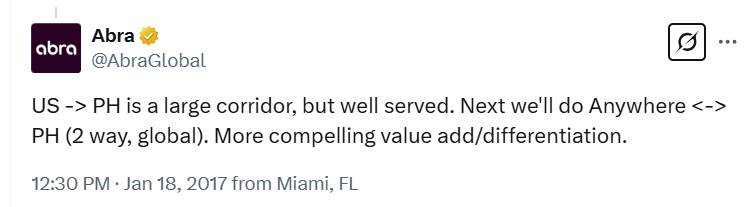
Sixteen months after a $12 million funding round, Abra all but gave up on its original pitch. It focused almost exclusively on a wallet play and pitched it as global domination:
Ultimately, Abra’s initial focus on remittances repeated Boom Financial’s strategy in the same space. Founded in 2008 by Abra’s management, Boom was pitched as “the first cross-border mobile banking service in the US” (on a side note, Remitly made the same claim in 2012). From 2008 to 2012, Boom raised $28 million from RRE Ventures and others, and… nothing.
Out of all the failed Bitcoin remittance startups, Abra’s pivot was the most disappointing. On paper, its target segment and user experience were distinctive and promised real change for a large portion of cash remittance users. Instead, Abra became another mundane wallet app for better-off consumers with bank accounts. In just 2 years, Abra’s focus changed from helping “Mexican named Bill” with cheap remittances to helping affluent American Express cardholders invest in Bitcoin for a 4% fee:
In October 2017, Abra raised $16 million to offer credit installments. Here is how Abra’s founder explained their failure in cross-border transfers:

In Conclusion: Production Use Is Real; Broad Consumer Transformation Is Still Unproven
After 15 years, direct crypto remittances remain either tiny or unverified. El Salvador’s crypto-wallet share is below 1%; our estimate puts direct crypto-native remittances in the Philippines at around 1%; and Bitso’s extraordinary claim of more than 10% of the U.S.–Mexico corridor still lacks the transaction-level disclosure needed to know what it actually measures. Félix and Aspora are now scaling fast enough to matter.
The important change in 2026 is that stablecoin infrastructure is becoming real and increasingly invisible to consumers. Major MTOs now have products in production, while our Philippines estimate suggests that stablecoin B2B2C use through Coins.ph may already be larger than direct crypto remittances. But production is not transformation. Funding, FX, compliance, liquidity, payout, cash-out, fraud, support, and customer acquisition still determine the end-to-end economics.
No provider has yet shown, with independently verifiable data, that stablecoins materially reduce the customer’s total price or improve availability, reliability, or coverage at scale. Stablecoins can become useful infrastructure without yet winning any of the three consumer-remittance tests in this article: solve a customer problem incumbents leave unresolved, support a business model incumbents cannot match, or create new transfer demand.
If you know of a crypto-based remittance provider with substantial volumes, please share details in the comments.